






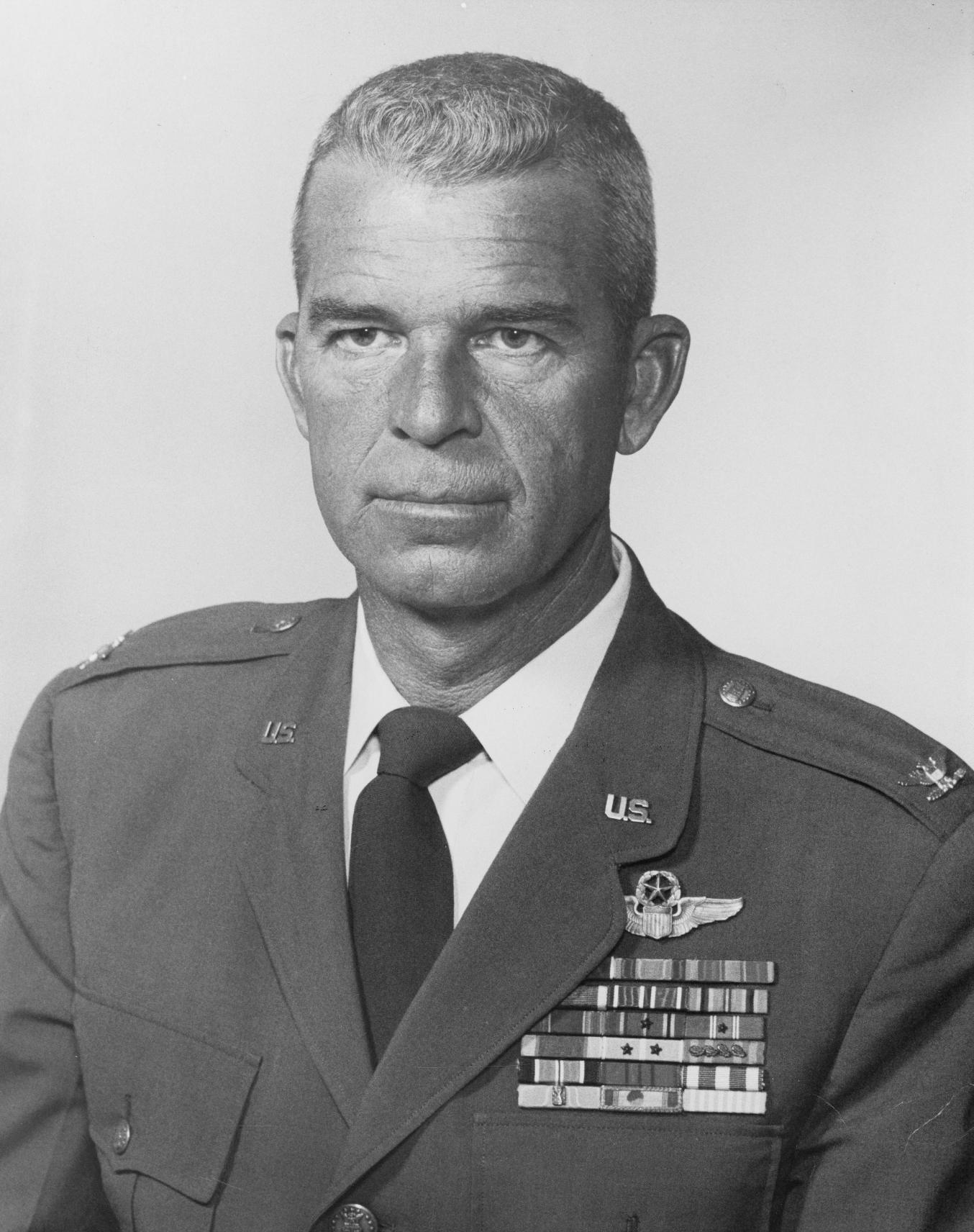
George Dewey Rawlings is honored on the following 1 monument(s) in our database:
B-17 'Boot Hill' (42-29767) & French Resistance Assistance Memorial
George Dewey Rawlings was born on March 2, 1922, in Faxon, Comanche County, Oklahoma. He was the son of George Dewey Rawlings and Ruby Inez Perry. He was married to Joan Hughes Rawlings. He attended Tuttle High School, graduating in 1940, before enrolling at the University of Oklahoma. Following the outbreak of World War II, he enlisted in the U.S. Army Air Corps and completed bombardier training aboard the B-17 Flying Fortress, receiving his commission as a Second Lieutenant in August 1942. Assigned to the 96th Bombardment Group, Rawlings underwent further training at Pocatello, Idaho, and Pyote, Texas, before deploying to England in April 1943.
Stationed at RAF Grafton Underwood, Rawlings experienced two aircraft losses within the first week of the group's combat operations. On May 13, 1943, during the 96th Bombardment Group's first combat mission, his B-17 was accidentally damaged by its own waist gunner, leaving the aircraft unable to land safely. After the enlisted crew members parachuted to safety over the airfield, the officers flew the bomber over the North Sea to dispose of its bomb load. Rawlings subsequently bailed out and landed safely on a beach near King's Lynn, England, although the aircraft's pilot, Captain Derrol W. Rogers, was killed.
Four days later, on May 17, 1943, Rawlings was assigned as a replacement bombardier aboard B-17F #42-29767, "Boot Hill," during a bombing mission against German military installations at Lorient, France. The bomber sustained severe damage from German anti-aircraft fire and attacks by Luftwaffe fighters, forcing the crew to abandon the aircraft over occupied Brittany. Rawlings successfully parachuted to safety but was captured by German forces and subsequently interned at Stalag Luft III in Sagan, Lower Silesia, where he remained a prisoner of war. In January 1945, as Soviet forces advanced toward the camp, he and other prisoners were forced to march through harsh winter conditions before eventually reaching Stalag VII-A in Moosburg, Bavaria. He remained in captivity until April 29, 1945, when the camp was liberated by the U.S. 14th Armored Division under General George S. Patton's Third Army.
Following his liberation, Rawlings returned to the United States and continued his military career in the newly established United States Air Force, completing pilot training at San Angelo, Texas. Over the course of his 30-year military career, he flew combat missions during the Korean and Vietnam Wars and held several command assignments, including the 75th Air Transport Squadron, 458th Tactical Airlift Squadron, RAF Chelveston, and RAF Alconbury. His final assignment was as Inspector General at Kelly Air Force Base, Texas, where he served for three years before retiring in 1972 with the rank of Colonel.
Following his military retirement, Rawlings remained actively involved in civic and charitable organizations in San Antonio, Texas. He served as a Bexar County election judge for 13 years and held several leadership positions, including President of the Boysville Board of Directors and the San Antonio Optimist Club. His dedication to community service earned him numerous honors, including the Optimist of the Year award in 1975–1976 and recognition as a Boysville Archangel in 1984. Col Rawlings died on January 16, 2011, and is now buried in the Fort Sam Houston National Cemetery, San Antonio, Bexar County, Texas, USA.
Sources of information: www.findagrave.com, francecrashes39-45.net