






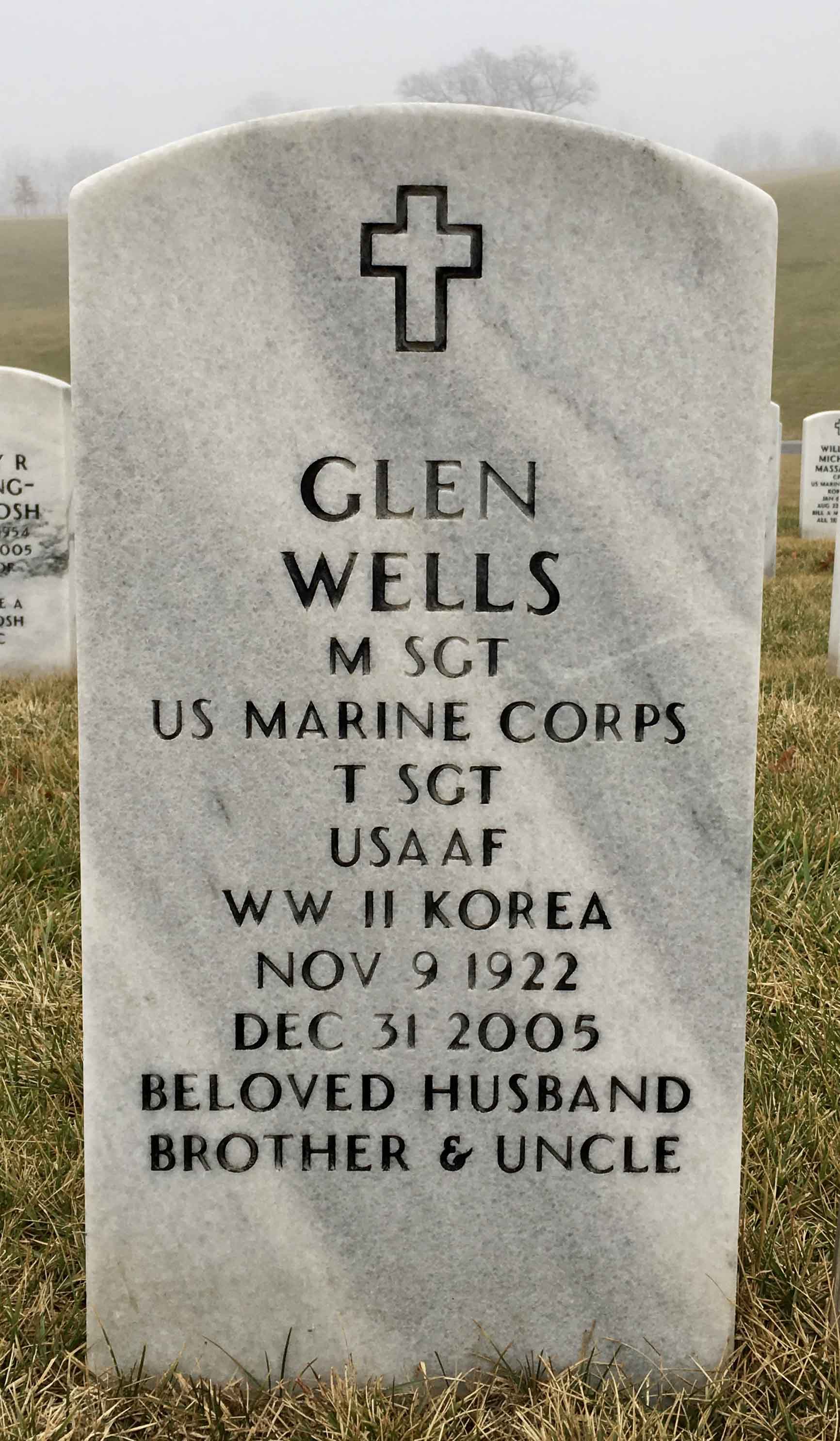
Glen Wells is honored on the following 1 monument(s) in our database:
B-17 'Boot Hill' (42-29767) & French Resistance Assistance Memorial
Glen Wells was born on November 9, 1922. He was married to Mary Alice Nurre Wells. He served with the 338th Bombardment Squadron, 96th Bombardment Group, Heavy, as a Technical Sergeant and Radio Operator/ Gunner of B-17F #42-29767, nicknamed "Boot Hill," during World War II.
On May 17, 1943, the "Boot Hill" was shot down over Brittany, France, during a bombing mission against German military installations at Lorient. Piloted by 1Lt Louis Lafayette Haltom, the aircraft was among 20 bombers dispatched by the group that morning, departing England at approximately 8:30 a.m. Before reaching the French coast, the bomber encountered mechanical difficulties when the supercharger on its No. 3 engine failed. Despite the malfunction, Haltom continued the mission. During the bombing run, the aircraft was struck by German anti-aircraft fire, damaging its engines and right horizontal stabilizer. Although the crew managed to complete the bombing run, the damaged Flying Fortress began losing speed and altitude, gradually falling behind the main formation. While attempting to return to England, the isolated bomber came under attack from German Focke-Wulf Fw 190 fighters, which inflicted further damage and wounded several crew members. With two engines severely damaged and the aircraft unable to maintain altitude, Haltom realized that reaching the English Channel was no longer possible and ordered his crew to bail out. The surviving airmen parachuted into the countryside of occupied Brittany before the crippled bomber crashed near Kéramprès, approximately four kilometers southeast of Plonévez-du-Faou in the Finistère department of France, at around 12:30 p.m. Of the eleven crew members aboard, two were killed, German forces captured three, and six successfully evaded capture with assistance from local French civilians and Resistance networks.
As B-17F "Boot Hill" sustained severe damage from German anti-aircraft fire and fighter attacks on May 17, 1943, TSgt Wells abandoned his radio equipment to help defend the aircraft. Together with flight engineer TSgt Marshall, he fired upon an attacking German fighter, which was seen trailing smoke as it disappeared from view. When pilot 1Lt Haltom ordered the crew to bail out, Wells attempted to escape through the damaged waist exit with the assistance of the wounded Sgt Loudenslager. After struggling to force the jammed door open, Loudenslager pushed Wells clear of the aircraft with his uninjured leg. Wells successfully deployed his parachute and landed near Corlay, France, where a local woman provided shelter and arranged for him to receive civilian clothing. He was later reunited with Marshall and several other surviving crew members. Wells, Marshall, Roy Martin, and William Martin eventually reached Saint-Quay, where Countess Betty de Mauduit sheltered them at her château. By mid-July, the six surviving evaders had reunited and continued their escape through occupied France with assistance from local civilians and Resistance members, including Vladimir Bouryschkine. After reaching Paris, Wells separated from the others before rejoining Marshall for the journey toward Spain. He successfully crossed the Pyrenees and reached Gibraltar, returning to Allied control on August 19, 1943, after approximately three months of evading German capture.
Following World War II, TSgt Wells enlisted in the U.S. Marine Corps and served as a radio operator with Marine Transport Squadron 152 (VMR-152) during the Korean War. In December 1950, he participated in critical air support operations during the withdrawal from the Chosin Reservoir, serving aboard a modified Douglas R5D aircraft that coordinated air strikes and communications for retreating Marine forces. On December 9, he spent approximately twelve hours airborne supporting the withdrawal toward Koto-ri. Wells later served for four years as senior aircrewman aboard the personal aircraft of Marine Corps Commandant General Lemuel C. Shepherd Jr., who recognized his service and ensured he received documentation for his second Air Medal in 1955. He died on December 31, 2005, and is now buried in the Leavenworth National Cemetery, Leavenworth, Leavenworth County, Kansas, USA.
Sources of information: www.findagrave.com, www.rumboogiecrew.com, francecrashes39-45.net,rcmcollection.com