






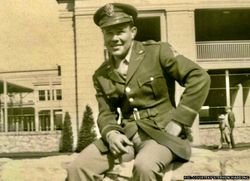
John Carey “Jack” Jr. Lee is honored on the following 1 monument(s) in our database:
Battle of Itter Castle (May 1945) Information Sign -12th Armored Division
Jack Lee was born in Omaha, Nebraska on March 12, 1918, to Dr. John C. Lee Sr. (Norwich High School Class of 1910) and Mary Agnes (nee Fleming) Lee. The family moved back to Norwich, New York in the mid-1920s, where Dr. Lee opened a medical practice. The Lee family lived at 155 East Main Street in Norwich, New York. Jack was the oldest of four children with two younger brothers William and David and a younger sister, Mary.
Jack was a gifted athlete. In Norwich High School he lettered in football and was a star wrestler in the 165 pound class. After graduation in June 1937, Jack enrolled at Syracuse University and continued wrestling. As a freshman, he was awarded a varsity S letter at a ceremony in Archbold gymnasium for wrestling. Jack returned to Syracuse in the fall of 1938. For reasons unknown today, Jack transferred in mid-year to Norwich University, Northfield, Vermont, where he played football as an offensive lineman (he was 5’10” tall and weighed 190 pounds) and later left guard. According to his army records, Jack majored in English.
Norwich University was a military academy producing officers for the United States Army and so, in addition to playing football, Jack became an ROTC cadet in the class of 1942. He excelled in football and according to The Norwich Sun, Norwich High School graduate and “star guard of Norwich University” received a contract to play pro football with the New York Giants in March 1942. Jack was offered $150 per game but according to a university spokesman “there was some chance that Jack would be unable to play next fall” because he was being commissioned into the army. The article also noted that Jack had married Miss Virginia Fisher of Harrisburg, Pennsylvania on January 2, 1942.
Unfortunately, Jack never got his chance to play in the pros. He was commissioned as a second lieutenant in the cavalry on April 30, 1942. Jack graduated on May 11, 1942, with a Bachelor of Arts degree and went on active duty ten days later at Fort Knox, Kentucky. The cavalry branch was mechanized by then, and Fort Knox was the home of the army’s Armor School. Jack was trained as an armor (tank) officer. He was promoted to first lieutenant on March 5, 1943, and then assigned to Company H, 43rd Tank Battalion in the newly activated 12th Armored Division (the Hellcat Division) at Camp Barkeley, Abilene, Texas, on September 19, 1943. Jack was further reassigned to the 23rd Tank Battalion as a Sherman tank platoon leader on November 12, 1943. He would remain in this battalion until the end of the war.
Jack deployed with the Hellcats and he arrived in England on October 3, 1944. According to his army instructors Jack had a natural talent for soldiering and tactics. Many who knew him at Norwich University said he had “a swashbuckling personality.” Regardless of his personality, by the fall of 1944, Lieutenant Jack Lee was a very experienced soldier and a highly trained armor corps officer. The division deployed to Le Havre, France on November 11, 1944, moving east to join the U.S. Seventh Army on the front lines.
The 12th Armored Division Hellcats were committed to combat near Weisslingen in French Alsace on December 5, 1944, and fought in the desperate winter battles near Luneville, France and then against the German-held Maginot Line. Jack’s performance in combat was brilliant. He was promoted quickly to command Company B, 23rd Tank Battalion, on December 10, 1944. The winter conditions were brutal; cold and snow brought trench foot and frostbite casualties, problems more commonly associated with the well-known Battle of the Bulge (then raging to the north in the Ardennes at the same time) to the battalion’s soldiers.
Company B fought in the bloody Battle of Heerlisheim, January 8–20, 1945 and then in February fought in the reduction of the Colmar Pocket. Jack’s leadership and heroism surfaced here. He was awarded a Certificate of Merit for recovering two wounded soldiers under heavy enemy fire. Jack was driven back at first but rescued them later under cover of darkness. The opportunity to display his innate talents arose again from March 17–23, 1945, when Jack was awarded the Bronze Star Medal for the “cool and aggressive handling of his platoons, and his courage and ability to meet any situation that confronted him.”
The division crossed the Rhine River into Germany and was assigned to General George Patton’s U.S. Third Army on March 19, 1945. In April, the battalion fought through Dillingen, Germany, then Kizingen, Nuremberg, and south to Landsberg; always moving fast and attacking. On April 16, the 23rd Tank Battalion organized an ad hoc combined arms task force, Task Force Lee with Jack in command, composed of his B Company of Sherman tanks, the battalion’s 4.2″ mortar platoon, and the 3rd Provisional Platoon/US Seventh Army. The 3rd Provisional Platoon was one of fifty-three ad hoc infantry platoons organized with African-American volunteers. The 12th and 14th Armored Divisions were the only armored divisions to receive these much needed reinforcements. Jack Lee was one of the relatively few white American army officers to command Black soldiers in World War II. The circumstances are unknown today, but Jack was wounded in action on April 21st and received the Purple Heart Medal.
The army promoted Jack to captain on May 1, 1945, and his tanks rolled into Starnberg the next day, poised to continue attacking into Austria. The end of the war in Europe was fast approaching and everyone in the army knew it. Authors like SLA Marshall and Studs Terkel noted the “last man to die syndrome” as soldiers became cautious and risk averse as VE Day (Victory in Europe) approached. Jack Lee, however, fought on and put himself in harm’s way when he could have chosen otherwise.
On May 4, 1945, Task Force Lee advanced south along the Inn River, capturing Kufstein, Austria. A German officer told Jack that German troops in the town of Worgl, ten miles to the south, were ready to surrender. Jack asked for and received permission to proceed with the Germans to attempt negotiations. Enroute Jack removed explosive demolition charges from the bridges at Eastengstatt and Gratte. During negotiations with German army Major Josef Gangl, Jack learned from a French civilian that there were a number of important French political prisoners held by the SS at the Castle Itter, about five miles southeast of Worgl. These included ex-French prime ministers Paul Reynaud and Édouard Daladier, former commanders-in-chief Maxime Weygand and Maurice Gamelin, eight times world tennis champion and former Vichy minister of sports Jean Borotra, and other prominent figures. They all expected to be murdered by the SS. Jack Lee decided to see for himself and, after a frank talk between the two officers, Gangl decided to help the Americans.
Lee and his gunner, Corporal Edward Szymeyk, were the lone Americans riding in Gangl’s kübelwagen (a military Volkswagen) as they drove up to the castle. After meeting with the French, Jack promised to return and free them. On the way back to Worgl, Jack bluffed groups of German soldiers into surrendering. Returning to Kaufstein, Jack organized a relief column of seven Sherman tanks and a platoon of African-American infantry, and led them back to Worgl. They arrived about 9 pm and Jack placed them in defensive positions. Then Jack in his personal Sherman tank, named the Besotted Jenny, with Szymeyk and five of his soldiers, drove up the dark and narrow road to the castle. There they found the German army guards were preparing to abandon their posts because SS troops were expected soon. Jack brought in his tiny force and convinced the Germans to stay. By 11 pm Jack and Major Gangl had organized a joint American-German defense, with the Besotted Jenny guarding the castle entrance and German machine guns on the walls.
“Jack Lee was one of the relatively few white American army officers to command Black soldiers in World War II… a man of action, best suited for playing contact sports or leading his soldiers in the attack on the battlefield.”
They had arrived in the nick of time. A four-man SS patrol probed the defenses at 4 am, May 5th, but it was quickly repulsed. By 8 am, more SS arrived and about 9:30 am the SS brought up three of the dreaded 88 mm anti-tank guns, while SS infantry surrounded the castle. At 10 am, the SS assault began with the 88’s shelling the defenders and SS infantry mounting attacks. The Besotted Jenny was hit six times by the 88s. All fourteen French prisoners, including the women, joined the twenty German and seven American soldiers — giving Jack a multi-national force of forty-one defenders. A heavy firefight lasted until 2 pm when the SS began to withdraw, leaving only a few snipers. The reason for their departure became obvious at 4 pm when a large American relief column of Sherman tanks and infantry rolled up to the main gate of Schloss Itter. Sadly, Major Gangl and two of his men were killed along with two of the German army castle guards. No Americans or French became casualties.
The next day, the 23rd Tank Battalion was ordered to Augsburg, Germany. Early in the morning of May 7, 1945, the battalion received word that Germany had surrendered. The Hellcat News ran the story of Castle Itter in the weeks that followed and Jack and his gunner, Corporal Edward Szymeyk, were singled out for praise. Jack Lee was recommended for the Distinguished Service Cross, the nation’s second highest medal for heroism in action.
Captain Jack Lee was awarded the Distinguished Service Cross. His citation reads: “For extraordinary heroism in action, as Commanding Officer of Company B, 23rd Tank Battalion, in the vicinity of Worgl, Austria, and the Itter Castle on 4–5 May 1945. Captain Lee, with a small group of soldiers infiltrated into hostile territory, demoralized enemy forces, prevented the destruction of two key bridges, and caused 200 German soldiers to surrender. He found many prominent French prisoners at Itter Castle and immediately organized a defense with both American and German troops. Despite a fanatical SS attack and heavy artillery barrage, Captain Lee’s men held until friendly troops arrived. Captain Lee’s initiative, boldness, courage, resourcefulness, and outstanding qualities of leadership exemplify the highest traditions of the Army and the United States.”
Jack returned to the states on January 26, 1946, and went on terminal leave five days later. He was honorably discharged at Fort Dix, New Jersey on April 27, 1946. In addition to the Distinguished Service Cross, Bronze Star and Purple Heart Medals, the army awarded Captain Jack Lee the American Campaign Medal, the European-African-Middle East Campaign Medal, and the World War II Victory Medal. His exploits were featured in The Saturday Evening Post.
.
Captain John C. Lee Jr. is buried in St. Paul’s Cemetery, Norwich, NY.
Nothing captures that extraordinary day in Jack Lee’s life better than an anecdote from Stephen Harding, who related that a newspaper reporter once asked Jack Lee how he felt about “the Last Battle.” Jack paused thinking for a minute and replied, “Well, it was just the damnedest thing.”
Source: https://chenangohistorical.org/journal/captain-jack-lee-schloss-itter/