






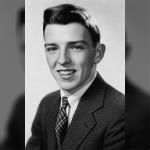
Roland Chapman Boulter is honored on the following 1 monument(s) in our database:
Roland Chapman Boulter was born on October 3, 1921, in East Walpole, Norfolk County, Massachusetts. He was the son of Curtis Lord Boulter and Mary MacDonald Boulter. He attended Walpole High School and later completed two years of college, aspiring to become an architectural engineer. In 1940, he was employed as a box maker at a paper mill before taking a position at the Pennsylvania State College of Optometry in Philadelphia. He enlisted in the service on July 21, 1942. He served in the 786th Bomber Squadron, 466th Bomb Group, Heavy, as a Second Lieutenant and Navigator of B-24H #42-52610, nicknamed ''The Madame'' during World War II.
On April 8, 1944, B-24H Liberator The Madame, piloted by First Lieutenant Kenneth Kessenger, was shot down over Germany during an Eighth Air Force bombing mission targeting Brunswick. Operating from RAF Attlebridge in Norfolk, England, the aircraft took part in a major bombing operation that became known among returning airmen as “Unholy Saturday” because of the heavy losses sustained that day. The mission began with a briefing at approximately 4:00 a.m., followed by a scheduled takeoff at 8:00 a.m. The 466th Bombardment Group dispatched 30 aircraft, which dropped more than 62 tons of bombs on their targets. However, six B-24 Liberators, including The Madame, failed to return. As the bomber formation entered German airspace, Luftwaffe fighters met it with intense opposition. Flying at altitudes between approximately 21,000 and 23,000 feet in the area between Gardelegen and Brunswick, the aircraft came under heavy enemy attack. The Madame was struck by anti-aircraft fire over the target area but managed to release its bomb load and rejoin the formation, although the damage had considerably reduced its speed. During the return flight, the crippled bomber was attacked by German Focke-Wulf Fw 190 fighters. One of the attacking aircraft opened fire on the fuselage, severely damaging the tail section and wounding a waist gunner, who lost three fingers to shrapnel. Other crew members attempted to provide medical assistance as the bomber continued to struggle through enemy territory. As the aircraft's condition deteriorated, Kessenger fought to keep the severely damaged Liberator airborne long enough for his crew to escape. Despite the increasingly desperate situation, he remained at the controls while the other airmen prepared to abandon the aircraft. Confusion arose inside the bomber as crew members attempted to determine who had already escaped, while several others worked to free the flight engineer, who had become trapped in the bomb bay. Shortly afterward, the aircraft's engines exploded, sending the bomber into an uncontrollable spin. Of the nine airmen aboard, five survived and were captured by German forces, while four other crew members were killed.
2Lt Boulter was Killed in Action and he is now buried in the Ardennes American Cemetery and Memorial, Neuville-en-Condroz, Arrondissement de Liège, Liège, Belgium. He also has a cenotaph in the Charles Sumner Bird Memorial Cemetery, Norwood, Norfolk County, Massachusetts, USA.
Sources of information: www.findagrave.com, www.466thbga. com, www.crouze.com, www.abmc.gov