






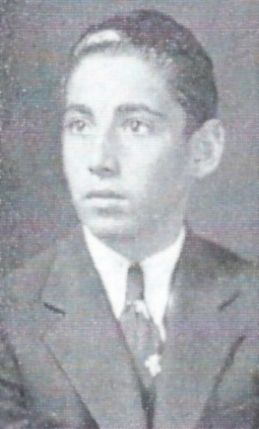
Sigmund Spritz is honored on the following 1 monument(s) in our database:
Sigmund Spritz was born on August 6, 1917. He was married to Dorothy Libin Spritz. He graduated from Baltimore City College in 1933 before earning a bachelor's degree from Towson State College in 1940. He worked as an elementary school teacher before enlisting in the U.S. Army Air Corps in 1941. He served in the 328th Bomb Squadron, 93rd Bomber Group, Heavy, as a Second Lieutenant and Navigator of B-24 #42-7614 nicknamed ''Buckeye" during World War II.
On January 7, 1944, the B-24 Liberator Buckeye participated in a strategic bombing mission against Ludwigshafen, Germany, a major center for the production of synthetic fuel and chemicals. Before reaching its target, the bomber sustained anti-aircraft damage when flak struck the cooling system of Engine No. 4. After completing the bombing run, the aircraft began its return flight to England, but Engine No. 4 was hit again and failed, forcing the Buckeye to leave the formation as it steadily lost speed and altitude. Shortly afterward, Engine No. 2 was also disabled by anti-aircraft fire, while ruptured fuel lines filled the aircraft with gasoline fumes, requiring the crew to wear their oxygen masks for protection. As the damaged bomber crossed occupied France, it passed over the Eiffel Tower before turning west, only to come under heavy German anti-aircraft fire again near Melun and Pringy. Additional flak destroyed the aircraft's radio, intercom, and compasses, wounded the flight engineer and radio operator, and left one engine ablaze. With the aircraft no longer controllable, the pilot ordered the crew to bail out. The Buckeye crashed near Pringy, Seine-et-Marne, while its ten-man crew parachuted from the stricken aircraft. Two airmen were killed in the incident, three were wounded, and five escaped without injury. Of the eight survivors, five were captured. They became prisoners of war, while the remaining three successfully evaded capture with the assistance of the French Resistance and escape networks before eventually returning to Allied control.
Spritz evaded capture for nearly three months with the assistance of French civilians, members of the Resistance, and an English woman connected to underground escape networks. His escape ultimately failed after a British torpedo boat attempting to evacuate him struck a reef and drifted back to the French coast, where its occupants were captured. After convincing the Gestapo that he was an airman rather than a spy, he was imprisoned and eventually transferred through several prison camps before being sent to Stalag VII-A at Moosburg, Germany.
After the war, Spritz was discharged with the rank of First Lieutenant. He later earned a degree from the Illinois College of Optometry in 1949 and established an optometric practice in Dundalk, Maryland, where he worked until his retirement in 1987. A longtime volunteer with the American Red Cross, he credited the organization's relief parcels with saving his life during captivity. He died on January 5, 1994, and is now buried in the Baltimore Hebrew Cemetery, Reisterstown, Baltimore County, Maryland, USA.
Source of information: www.findagrave.com, americanarchive.iwm.org.uk