






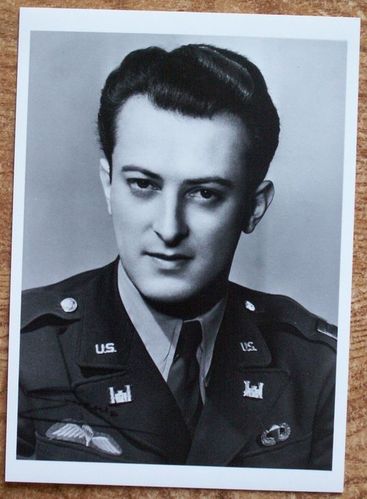
Victor Jerome Layton is honored on the following 1 monument(s) in our database:
Operation Citronelle Interallied Monument (OSS, SOE and French Resistance)
The Colonel of the United States Army, Victor Jerome Layton, the American of the Citronelle mission, died on August 8 at his home in St Croix Falls (Wisconsin, USA).
The result of the union of Arthur and Margaret Lustig, the Czech director of a branch of the Bank of Central European Countries, an Austrian national, Victor was born on November 28, 1921 in Vienna. Until the age of 7 he grew up in this city, then the family moved to France, in Paris. Fluent in German, his native language, and French, he enriched his linguistic background in England, where in 1936 his parents sent him to study. War is coming. In June 1940, the Lustig family experienced the exodus, which led them to Royan, where they were joined by German troops. Back in Paris, Victor's father resumes his activity while Victor himself, thanks to false papers, prepares his passage to Spain. In early 1941, embarked on a Portuguese ship bound for the United States, landed in Hoboken, New Jersey on January 22, 1941, he "boarded" in New York to continue his studies. Naturalized American, he abandons his name with too Germanic consonants for that of Layton. In September 1942, he was hired in the army as a Engineering officer, then was sent to Europe in the ranks of the American special services, the OSS (Office of Strategic Services) in June 1943. Young lieutenant, he is made available to the SOE in London. Thanks to (or because of) his perfect mastery of the French and German language, he was anticipated, at the beginning of 1944, to participate in the interallied mission Citronelle, which was dropped near Mourmelon (Marne) on April 12, 1944 at night.
Victor Layton Within Citronelle, Victor's role is to ensure the stewardship of the maquis: it is he who inventories the contents of the packages and containers parachuted, who distributes the weapons, clothing and equipment received.
We saw in a previous article that in the early hours of the attack on the maquis on June 12, he was in the company of Desmond Ellis Hubble. Back at the camp, he participated in the first fighting, and had the weapons, explosives and all the equipment buried that the guerrillas could not transport while Prism decided to break at the darkest of the night to escape the German troops. When the maquis starts, groups are formed very quickly and contacts with the commander are broken. Thus, Victor found himself at the head of a group of 90 men, with the objective of escaping the encirclement and rallying the hamlet of the Six Chênons, where he must resume contact with Prisme. On June 13, after trying in vain to cross the German lines, Victor and his group spent another night in the forest, without provisions and under a pouring rain.
The next day, the strength of his group, which had melted during the day as a result of defections, was reduced to nothing: only one man remained with him. In Les Six Chênons, which he managed to reach, no one is there. Victor then decides to reach Charleville to get back in touch with London, thanks to an FFI radio, and inform the staff of the dramatic situation of the maquis. After swimming across the Meuse (at the height of Bogny), under the bullets of German sentinels, and after an exhausting journey, he arrived in Charleville where he went to his contact in this locality, namely the butchery of André and Jacqueline Faynot in the main street (now rue de la République), where he will find refuge for a few days before joining the Prisme maquis, reformed near Willerzie, in Belgium.
At the beginning of September 1944, Victor met the liberating troops at Fumay and was appointed to lead them to the Bastogne region. His mission fulfilled, he returned to Paris on a German motorcycle on September 12, then was sent back to Great Britain. After a short stay in the hospital, he was appointed liaison officer of Allied agents then on a spying mission in a struggling Germany within the 25th Bomb Group of the 8th Air Force (he flew over the country at very high altitude to communicate with undercover Allied agents, using special equipment mounted on one of Havilland Mosquito). After the war, he married in Germany, where he lived as a soldier belonging to the US occupation troops. From this union will be born three children. He participated, to varying degrees, in the Korean and Vietnam Wars. In 1952, he was assigned to the Army Transport Research Service, mandated by the US Air Force to find the means to install a radar base on the ice sheet, a few hundred kilometers from the North Pole. He therefore set up a reconnaissance expedition with the team of Paul-Émile Victor, with whom he formed bonds of friendship (a report of this "Operation Thulé" was published in the magazine Paris-Match. So I take the opportunity to call some reader who would have the number(s) in question...)
An aeronautical engineer, Victor continued in this branch and participated in 1963 in the development project of a twin-engine manufactured by de Havilland Canada. After leaving the army with the rank of Colonel in 1967, he participated, as a civil engineer, in various development projects in Africa. A man of many talents, of extraordinary dynamism and insatiable curiosity, Victor was still, for a few years, hotel manager and port captain (Harbor Master) in Northeast Harbor, Maine.
Victor retired to Wisconsin with his wife Emmy in 1988, to enjoy a well-deserved retirement.
We remember that during the last ceremony in tribute to the dead of the Manises maquis in which members of the Hubble family participated, Victor had sent a message that was given to them. With him, the last member of the Citronelle mission died.
Victor Layton had been decorated, for his action during the Second World War, with the War Cross (France), the War Medal (United Kingdom), and the Distinguished Service Cross.
DSC Citation: "For extraordinary heroism in connection with military operations against an armed enemy while serving with Office of Strategic Services, in action against enemy forces on 21 April 1944 to 12 September 1944. After having been parachuted into France, Captain Layton achieved his mission of organization, arming and training resistance forces with extraordinary courage and ability. Despite a large-scale enemy attack which caused the loss of most of the personnel which he had assembled against formidable obstacles, he managed his escape under intense enemy fire, with unabated persistence and coolness, reorganizing his group and led it in numerous successful attacks against the enemy. Captain Layton's unremitting cool, utter scorn for danger and brilliant performance of an extremely hazardous mission are illustrative of the finest military characteristics and do credit both to him and the United States Armed Forces."
Headquarters, European Theater of Operations, U.S. Army, General Orders No. 212
Distinguished Service Cross (DSC)
Source: https://ardennetiensferme.over-blog.com/article-victor-layton-l-americain-de-la-mission-citronelle-est-decede-55893293.html