






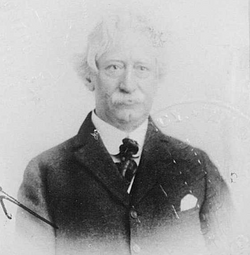
William Nelson Cromwell is honored on the following 1 monument(s) in our database:
William Nelson Cromwell. Born January 17, 1854, son of Col John Nelson Cromwell, Age 33 years. Fell at the Battle of Jackson, Miss in defense of the Union May 16 1863. Colonel 14th Illinois Infantry. Founder of
Co-founder of a prestigious law firm, Cromwell had earned an international reputation for financial and legal wizardry in corporate reorganization; one journalist dubbed him "the physician of Wall Street." His most spectacular legal feat involved the prolonged and complex negotiations that resulted in the construction of the Panama Canal. Representing the French owners of the franchise to the selected route, which they sold to the United States for $40 million in 1902, Cromwell devoted almost eight years of his life to what Arthur H. Dean, his biographer, called a "case that was all but lost." The successful outcome brought Cromwell additional French clients and he began to spend more and more time in France. During most of World War I he remained in his Paris home, lending his skills and much of his wealth to war relief efforts and, following the Armistice, to reconstruction measures for hard-hit sections of the French economy.
A born romantic, he was particularly proud of the Lafayette Escadrille, the volunteer corps of American aviators who flew for France before General John J. Pershing arrived with the American Expeditionary Force. He was a prime mover in the erection of the white marble temple in Paris where the 67 members of the Escadrille lost in combat are buried, and he personally endowed a fund for the memorial's maintenance in perpetuity.
William Nelson Cromwell, who left an estate of some $20 million when he died in 1948, was not born to wealth. Orphaned at an early age when his father was killed in the Civil War, he grew up in Brooklyn, New York, where his mother brought up her children "in Spartan living under extreme financial difficulties." On graduation from high school, he found a job as an accountant in a railroad office. Three years later he went to work for a law firm whose senior partner, Algernon Sydney Sullivan, encouraged him to attend Columbia Law School. He was admitted to the New York Bar in 1876. In 1879 the old firm was dissolved and Cromwell, only twenty-five years old, joined the much older Sullivan in a new legal partnership whose gross income, that first year, was $22,500. It was a modest beginning for Sullivan and Cromwell, which grew to be one of the world's largest law firms.
Cromwell never forgot the poverty of his youth. According to his biographer: "To the end of his life he carefully picked up paper clips or rubber bands on the floor, turned out electric lights and was saving and frugal in his habits." On the other hand, his personal life style was opulent. He spent little time in his office, conducting his business for the most part from a Manhattan mansion whose rooms, crowded with tapestries, paintings, and sculpture, were virtually museums of mid-Victoriana, or from an equally luxurious home in Paris. His appearance was also distinctive. John Foster Dulles, one of his law partners, described him as "an impressive figure with his shaggy white locks, his florid complexion and sparkling eyes."
It was this singular personality who succeeded to the presidency of the Permanent Blind Relief War Fund following the death of George Kessler on September 13, 1920, and it was he who directed a fundamental change in the Fund's program soon thereafter. Kessler's idea had been that the Fund would function in France and other parts of the Continent somewhat along the lines of St. Dunstan's in England, providing vocational training and education, supplementing inadequate government pensions, buying homes for those who had been taught hand crafts and establishing central purchasing and marketing facilities for their output.
Cromwell thought along different lines. Such rehabilitation programs, he believed, should be maintained by the governments and philanthropies of the respective countries; American funds should be reserved for those services no single agency could manage. Among the activities begun by the Fund while hostilities were still under way was braille printing. This, Cromwell felt, was the sort of service that could benefit all of Europe's war-blinded. But he encountered considerable initial resistance to the proposal that the Fund's resources be used for the production of braille literature and music. Opponents pointed out that few of the war-blinded could read braille or were interested in mastering it. That, replied Cromwell, might be true at the moment, but it would change. Supply would create demand.
The Lafayette Escadrille Memorial was built in 1928 on land donated by France and with money given by, among others, the families of pilots. Its dwindling foundation began with a $1.5 million endowment in 1930 by William Nelson Cromwell.
Source: https://afb.org/online-library/unseen-minority-0/chapter-22