






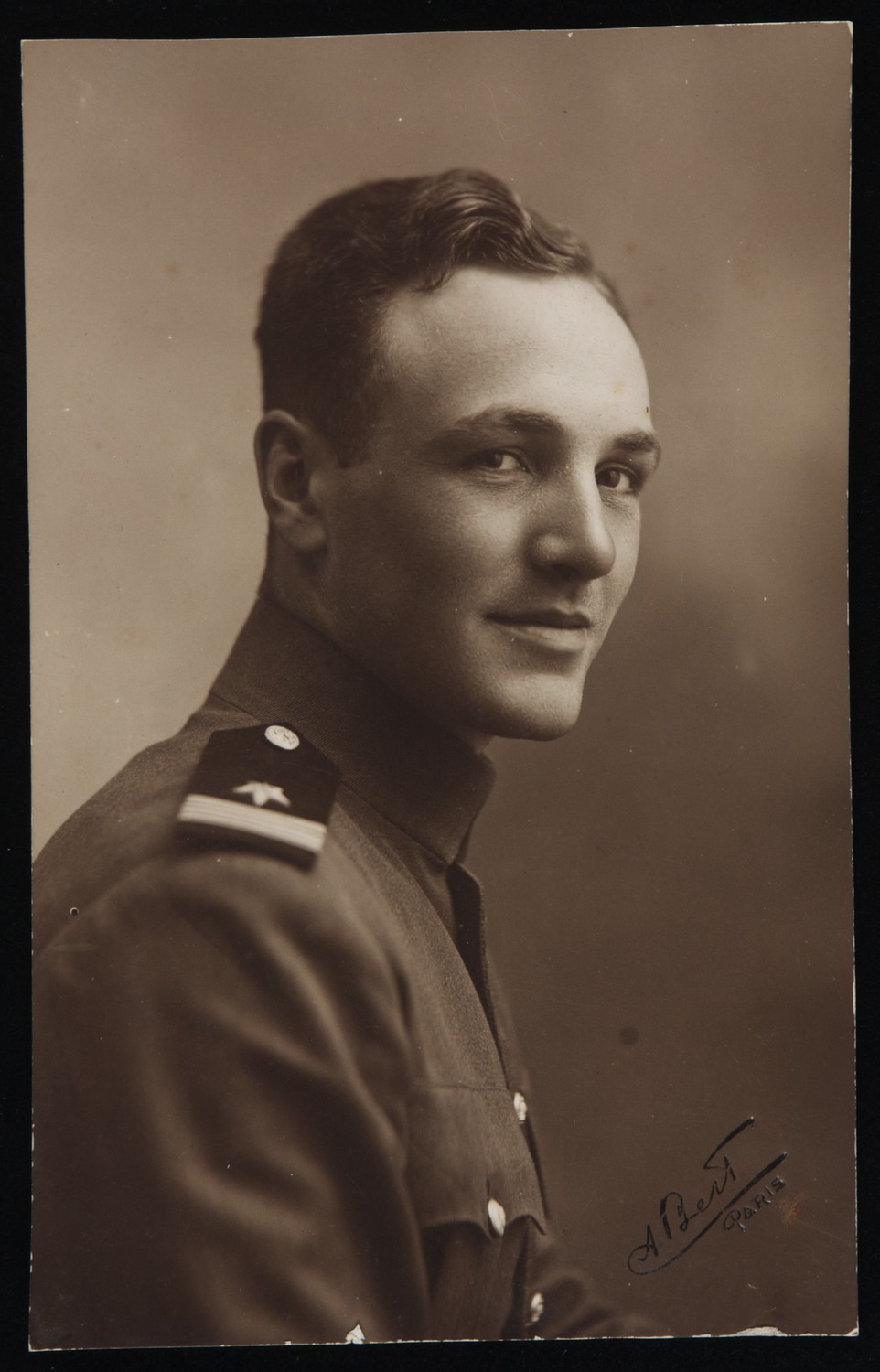
Kenneth MacLeish is honored on the following 1 monument(s) in our database:
Kenneth MacLeish was born on 19 September 1894 at Craigie Lea, his family’s home near Glencoe, Illinois, north of Chicago. His father Andrew MacLeish had emigrated to America from Scotland in 1856. Andrew quickly established himself as a dry goods merchant. He became very successful, and wealthy. In 1888, he met and married Kenneth’s mother, Martha Hillard. Martha was descended from a wealthy and proud New England family that could trace its roots back to the Pilgrims. Kenneth was their third son, after Norman and Archibald. After Kenneth, came a sister Isbhbel (sic.).
Kenneth’s parents clearly had high expectations for Kenneth, and he did his best to live up to them. He entered Yale in the autumn of 1914, where he was a distiguished athlete and active in the Yale Home Mission. Kenneth also made two very important decisions while he was at Yale.
The first decision he made was to join the First Yale Unit. Founded at the intiative of a Yale student named F. Trubee Davison, the unit consisted of twelve young men who were fascinated by the brand new field of aviation, and naval aviation in particular. They decided that they were going to become naval aviators. Trubee Davison got his hands on a Curtis Model F Flying Boat and the young men began learning how to fly it. They, or their families, paid for their training out of their own personal funds. When Admiral Peary learned about the unit, he gave them official authorization to conduct coastal aerial patrols, even though they were still only civilians and volunteers. In August of 1916, Congress created the Naval Reserve Flying Corps. The twelve joined the Naval Reserve Flying Corps on 24 March 1917, thirteen days before America entered the war. They were part of America’s first group of 42 navy aviators. (He is Naval Aviator # 74)
The second very important decision that Kenneth made at Yale was to fall in love with Priscilla Murdoch. Priscilla was from a less-fortunate background than Kenneth, and his parents did not approve. However, Kenneth loved Priscilla anyway. He became secretly engaged to her, and planned to marry her after he returned from the war. Throughout his time in Europe, Kenneth wrote many letters to Priscilla. He asked her to keep the letters so that he might turn them into a journal or a diary after the war.
In October of 1917, Kenneth shipped to Europe, and underwent training with the British Royal Air Force for several months. He learned to fly a variety of aircraft, including the French FBA Flying Boats, Hanriot-Dupont Scouts, and Breguet Bombers. He also learned to fly the British DH9s, and the Sopwith Camel. Of all of the aircraft, Kenneth loved the Sopwith Camel the most. It was the fastest aircraft the British had during the war.
As of March 1918, Kenneth entered active combat when he was sent to Dunkirk in France. He served in several different duty stations with the British, and in several different squadrons, both in France and in England. He acquired considerable combat experience in escorting ships, bombing ennemy targets, and engaging in air-to-air dogfights with the Germans.
On 14 October 1918, Kenneth went out on a morning patrol with the Royal Air Force’s 213th Squadron based in Dunkirk. He was flying one of his beloved Sopwith Camels. It was a successful mission in which he shot down a German plane and returned safely to base. However, that afternoon, Kenneth took his Sopwith Camel back up on another patrol, and never came back.
No one from the Squadron saw Kenneth’s plane go down, and no one knew what happened to him. They all held out hope that he was still alive, either as a Prisoner of War or in hiding from the Germans. When the War ended on 11 November, there was still no trace of Kenneth, and he did not appear on the German POW rosters.
On 26 December 1918, a Belgian farmer Alfred Rouse returned to his devasted farm in Schoore. The farm had been located in the middle of the fighting, and it was the first time that Rouse had been able to see his farm since the war began. While inspecting the property, Rouse discovered the machine-gun-riddled wreakage of Kenneth’s aircraft. Some 200 meters away, he discovered Kenneth’s body, and, from the position of the body it looked like he had been crawling. Thus, it appears that Kenneth had survived the crash and had been trying to crawl to shelter when he died. Rouse buried Kenneth where he found him, and marked the grave with a cross. Kenneth was moved to the Flanders Field American Cemetery the next year.
One of Kenneth’s former commanders, Capitain David Hanrahan, wrote a letter of condolence to Kenneth’s family in 1919 in which he described Kenneth as “without exception, the most popular man in our force” and “one of the finest pilots who ever flew over the north country.” He went on to say that he had made special use of Kenneth because of his “all-around ability.”
As for Priscilla, she remained unmarried until 1927. Even after her marriage, she treasured Kenneth’s letters to her for the rest of her life. After her death, those letters, as well as others that Kenneth wrote to other family members, were collected together and published in a book under the title The Price of Honor.
Kenneth’s brother Archibald MacLeish served with the American Army in France in World War I. He went on to become a famous poet, and was awarded the Pulitzer Prize three times. His career culimnated when President Franklin Roosevelt nominated him to become Librarian of Congress, in which capacity he served during WWII. Archibald was deeply affected by his brother’s death. In the 1920s, long before he becamse famous, Archibald lived in Paris, and he travelled often to Belgium to visit his brother’s grave. Kenneth’s death inspired several of Archibald’s most famous poems, such as Memorial Rain, and The Young Dead Soldiers Do Not Speak.
Source: https://aomda.org/en/content/kenneth-macleish