






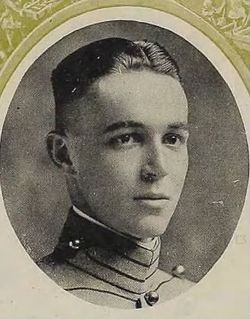
Hayden Adriance Sears is honored on the following 1 monument(s) in our database:
A superior once said of Hayden, “A splendid officer who occasionally needs to be check-reined but never needs to be spurred.” Seldom have so few words better captured the basic orientation of an individual’s life. A thinker and innovator, doer and leader, demanding and stern, he was at the same time compassionate and caring, humble and humorous, dedicated and loyal.
Hayden Adriance Sears was born 19 September 1899 in Brookline, Massachusetts, the son of Harold C. Sears, a Boston investment banker, and Jeanette Hayden Sears. He attended Saint George’s School in Newport, Rhode Island prior to being appointed to the Military Academy by Senator Henry Cabot Lodge. He entered the Academy on 14 June 1918. In addition to doing well academically, he participated actively in hockey and the choir while pursuing his love of horsemanship, which he continued well into his retirement years.
On being graduated in June 1920 he was commissioned in the Infantry but was transferred to the Cavalry in early September. From that time until the days foreshadowing World War II, he served in command and staff positions in the 1st, 2d, 9th, 13th and 26th Cavalry, principally in the Philippine Islands and at Forts Riley, Knox and Russell. He attended the Basic, Troop Officers, and Advanced Equitation Courses at the Cavalry School and later served there as a tactics instructor. As regimental personnel adjutant and troop commander, he planned, organized and conducted the march of the 13th Cavalry from Fort Russell, Wyoming to Fort Riley, Kansas, made between 16 June and 17 July 1927—probably the last of the long horse cavalry marches. From 1934 to 1936 he served as assistant military attache in Paris and as a diplomatic courier, “making 27 trips to Moscow”—an experience which provided firsthand knowledge of the terrain and the peoples he would encounter in World War II.
Despite his love of horsemanship, he was among the few early proponents of Mechanized Cavalry and the Armored Force. He recognized both armor’s potential and some of its problems—often recalling a story of competitions for “best tank.” The emphasis was on “spit and polish” to include polishing to a belt buckle sheen the fuel lines and connectors in the engine compartment. After a winner was chosen, a prearranged signal summoned an unmanicured tank to tow the winner off. Perhaps it was incidents such as this that reinforced Hayden’s view that facts are just that—not to be embellished or twisted but stated openly, plainly and honestly. It was this early armor experience plus his already established prominence as a trainer that made him a natural choice for G-3 of the 4th Armored Division when it was activated on 15 April 1941 at Pine Camp, New York.
In the fall of that year, shortly before the attack on Pearl Harbor, Hayden married Catherine Bradley Averill, daughter of Colonel and Mrs. Nathan K. Averill. Though they had met previously at Fort Riley, it was during his tour in Paris, where Dotty was attending the Sorbonne, that their relationship developed. For the next two years Dotty was destined to become a camp follower and the first lady of the 35th Armored Regiment. The division went from Pine Camp to maneuvers in Tennessee and the Mojave Desert and on to Camp Bowie, Texas. It was a period of intensive training and several reorganizations, the last of which in September 1943 found Hayden leaving the division for command of the 17th Armor Group at Fort Knox. Surely he was very disappointed at leaving the division he had done so much to train before it was committed to combat. However, his spirit was perhaps best exemplified by the names he gave to his three headquarters tanks: “Howdy Do,” “Can Do,” and “Will Do!”
He took the CCA, 4th Armored Division to England, then to France as part of the XII Corps before returning to the division during the latter phases of the Battle of the Bulge as commanding officer, Combat Command A. He led that command to and across the Rhine, Main and numerous other rivers eastward to the outskirts of Chemnitz where orders halted the advance. Then into Bavaria and northward into Czechoslovakia where the division was halted again until the Russians linked up. And lead he did—sometimes in his tank, more frequently in his jeep, which he insisted on driving himself. Impatient with delay, he personally found a way through or around any problem area. When the concentration camp at Ohrdruf was overrun, he escorted the senior officials of that city on a tour of that gruesome place.
His personal bravery and leadership are attested to by the numerous decorations he was awarded. These include the Silver Star with three Oak Leaf Clusters, the Legion of Merit, the Bronze Star for Valor, and the Purple Heart. From Great Britain he received the Honorary Companion of the Distinguished Service Order, from France both the Croix de Guerre with Palm and the Chevalier Legion of Honor, from the Union of Soviet Socialist Republics the Order of the War for the Fatherland, and from Czechoslovakia the War Cross 1939.
Post-war assignments included director of instruction, the Armored School; executive officer, 1st Constabulary Brigade; chief, Army Section, MAAG Denmark; and G-3, First Army. After retirement he put his leadership in business, for his church and particularly for the youth in his community. West Point Class of 1920.
Source: West Point Association of Graduates Website.