






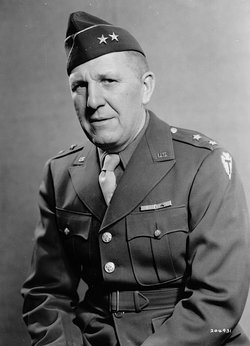
John Ernest Dahlquist is honored on the following 1 monument(s) in our database:
US Army General. During his military career, he commanded three different US Army divisions, commanded at the corps and field army level, and rose to the rank of four-star general. Born to Swedish immigrant parents, he graduated from the University of Minnesota at Minneapolis/St. Paul, Minnesota with a commission as a 2nd lieutenant in the US Army Infantry in 1917 and served in the occupation forces in Germany after World War I. From 1924 until 1928 he served as an instructor at the US Army Infantry School. After graduating from the US Army Command and General Staff School at Fort Leavenworth, Kansas in 1931, he was assigned to the Philippines. After returning to the US, he was a student at the Army War College at Carlisle Barracks, Pennsylvania from 1935 to 1936 and following graduation, he served on the US Army General Staff, Personnel Division in Washington DC. After the US entered World War II in December 1941, he was assigned as Assistant Chief of Staff, European Theater of Operations in 1942, and later that year he was promoted to the rank of brigadier general and became Assistant Division Commander of the 76th Infantry Division. In 1943 he was promoted to the rank of major general and became the first commander of the 70th Infantry Division, and the following year he became commander command of the 36th Infantry Division. During his time as commander of the 36th Division, he received his greatest criticism for his over-utilization of the Japanese American 442nd Regimental Combat Team. His decisions would, however, result in the 442nd becoming the most highly decorated unit in the history of the US military. When the Commander-in-Chief of the German Luftwaffe Hermann Goring surrendered to the 36th Infantry assistant division commander on May 8, 1945, he was transported by the assistant division commander, Brigadier General Stack to the division command post. Because he also spoke German, Dahlquist dismissed his translator, and he was the first person to question Goring. Press photos of him and Stack, in seemingly casual conversation with Goring, were released for publication back in the US, and it resulted in criticism of Dahlquist from the American public. He returned to the US and served in various administrative and personnel jobs before taking command of the 1st Infantry Division in 1949. This was followed by command of 5th Corps (1952 to 1953) and 4th United States Army (1953, with promotion to the rank of lieutenant general), and Chief of Army Field Forces (1953 to 1955), during which he was promoted to the rank of general in August 1954. He finished his career as Commander-in-Chief, Continental Army Command, and retired in 1956 with 39 years of continuous military service. His military decorations and awards include the Distinguished Service Cross, the Army Distinguished Service Medal, the Silver Star, the Legion of Merit, the Bronze Star, the World War I Victory Medal, the Army of Occupation of Germany Medal, the American Defense Service Medal, the American Campaign Medal, the European-African-Middle Eastern Campaign Medal, the World War II Victory Medal, the Army of Occupation Medal, and the National Defense Service Medal. In 1954 he received an honorary Master of Arts Degree from the University of Minnesota. He died at the age of 79.
DSC Citation Synopsis
The President of the United States of America, authorized by Act of Congress July 9, 1918, takes pleasure in presenting the Distinguished Service Cross to Major General John Ernest Dahlquist, United States Army, for extraordinary heroism in connection with military operations against an armed enemy while serving as Commanding General, 36th Infantry Division, in action against enemy forces during the drive from Bergzabern to the Rhine River, Germany, on 23 March 1945. Major General Dahlquist's extraordinary heroism, personal bravery and zealous devotion to duty exemplify the highest traditions of the military forces of the United States and reflect great credit upon himself, the 36th Infantry Division, and the United States Army.