






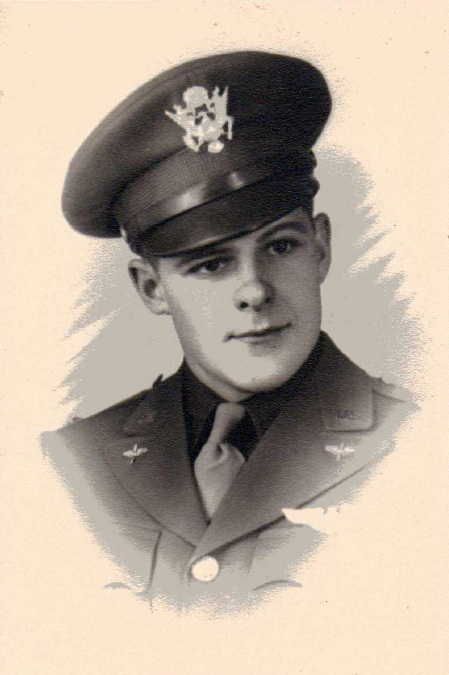
Leroy Arthur Dyer is honored on the following 1 monument(s) in our database:
LeRoy Arthur Dyer was born on December 25, 1920, in Michigan. He was the son of Arthur Henry Dyer and Flossie Mae Richardson Dyer. He graduated from Central High School in 1939. After graduating from high school, he worked for Consumers Power Company, registered for the draft in February 1942, and soon enlisted as a flying cadet in the U.S. Army Air Forces on March 13, 1942. He completed pre-flight training at Santa Ana Airfield (California), then continued to Williams Field (Arizona), where he earned his commission as a Second Lieutenant and his silver Bombardier wings. Advanced training was followed at Barksdale Field, Louisiana, and Carlsbad, New Mexico, before he was assigned overseas. He joined the 587th Bomb Squadron, 394th Bomb Group, flying the B-26 Marauder in England in July 1943. He became the bombardier of B-26 Marauder #42-107592 “Stinky,” flying numerous combat missions with his crew. By early 1944, he had completed more than 50 missions, earning multiple Air Medals, and in March 1944, he was awarded the Distinguished Flying Cross, recalling a hazardous mission to Holland where flak shattered the plexiglass nose of the aircraft.
On the morning of June 6, 1944, D-Day, B-26 Marauder 42-107592 “Stinky” was flying in formation toward its target over Normandy when it encountered heavy cloud cover and severe weather over Battle, Sussex, England. Visibility was extremely poor, with icing and turbulent cloud conditions. As the aircraft flew on instruments through dense overcast, it inadvertently collided with another Marauder, 42-96249 of the 587th Squadron, which had descended unexpectedly out of a thick cloud bank. The impact did not register as a strong jolt, according to the only survivor, Lt. Tommie Potts, but his aircraft soon entered an uncontrolled spin, eventually flipping onto its back. Potts ordered the bombs jettisoned to avoid ground explosions and then bailed out, becoming the sole survivor of both crews. B-26 “Stinky” crashed at Whatlington Level, while the other aircraft crashed at Ashburnham Place. The crews’ quick decision to release their bomb loads prevented further devastation on the ground.
1Lt Dyer's remains were first buried in England, later returned to Lansing in 1949, and he now rests in Pioneer Cemetery, South Branch Township, Crawford County, Michigan, USA.
Source of information: www.findagrave.com, www.fold3.com