




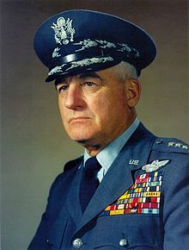
Nathan Farragut Twining
General, U.S. Air Force (Commander 15th Air Force)
Nathan Farragut Twining was born on 11 October 1897 in Monroe, WI, and came from a military background. His forebears had served in the U.S. Army and Navy since the French and Indian War. (He is the brother of U.S. Marine Corps General Merrill B. Twining and the nephew of U.S. Navy Rear Admiral Nathan C. Twining.) His mother was Frances Staver Twining, author of Bird-Watching in the West.
In 1913, Twining moved with his family to Oswego, OR, where he served in the Oregon National Guard from 1915-17. In 1917, he received an appointment to the U.S. Military Academy. Because the program was shortened so as to produce more officers for combat, he spent only two years at the Academy and graduated just a few days too late for service in World War I.
After graduating in 1918 and serving in the U.S. Army Infantry for three years, he transferred to the Air Service. Over the next 15 years he flew fighter aircraft in Texas, Louisiana, and Hawaii, while also attending the Air Corps Tactical School and the Command and General Staff College. When war broke out in Europe he was assigned to the Operations Division on the Air Staff; then, in 1942, he was sent to the South Pacific where he became Chief of Staff of the Allied air forces in that area.
In January 1943, he assumed Command of the Thirteenth Air Force, and that same November he traveled across the world to take over the Fifteenth Air Force from Major General Jimmy Doolittle. On 1 February 1943, the U.S. Navy rescued Brigadier General Twining, the 13th Air Force Commander, and 14 others, near New Hebrides Islands. They ditched their plane on the way from Guadalcanal to Espiritu Santo and spent six days in life rafts. When Germany surrendered, Arnold sent Twining back to the Pacific to Command the B-29s of the Twentieth Air Force in the last push against Japan, but he was there only a short time when the atomic strikes ended the war. On 20 October 1945, Twining led three B-29s in developing a new route from Guam to Washington via India and Germany. They completed the 13,167-mile-trip in 59 hours, 30 minutes. He returned to the U.S. where he was named Commander of the Air Materiel Command, and in 1947 he took over Alaskan Air Command.
After three years there he was set to retire as a Lieutenant General, but when Muir Fairchild, the Vice Chief of Staff, died unexpectedly of a heart attack, Twining was elevated to the four-star rank of General and named as his successor.
In 1947, Twining was asked to study UFO reports; he recommended that a formal study of the phenomenon take place; Project Sign was the result.
When Hoyt Vandenberg retired in mid-1953 due to prostate cancer, Twining was selected as Chief of Staff. During his tenure, massive retaliation based on airpower became the national strategy.
In 1957, President Dwight D. Eisenhower appointed Twining as Chairman of the Joint Chiefs of Staff. He was the first Air Force General to serve in that role.
General Twining retired from active duty in 1960.
Honors:
National Aviation Hall of Fame (1996):
A city park in Monroe, Wisconsin, Twining's birthplace, and an elementary school on the Air Force base in Grand Forks, North Dakota are named after him.
An extensive amateur astronomy observatory facility located in rural central New Mexico is named after him.
Death and Burial:
General Nathan Farragut Twining died on 29 March 1982 at Lackland Air Force Base, TX. He is buried at Arlington National Cemetery in Arlington, VA, in Section 30, Lot 434-2.
Source: Military Hall of Honor

PRIVATE CITIZENS SUPPORTING AMERICA'S HERITAGE
American
War Memorials Overseas, Inc.
War Memorials Overseas, Inc.

Twining Nathan Farragut
Name:
Nathan Farragut Twining
Rank:
General
Serial Number:
Unit:
15th Air Force
Date of Death:
1982-03-29
State:
Wisconsin
Cemetery:
Arlington National Cemetery Arlington, Arlington County, Virginia
Plot:
Section 30, Site 434-2
Row:
Grave:
Decoration:
Comments: