






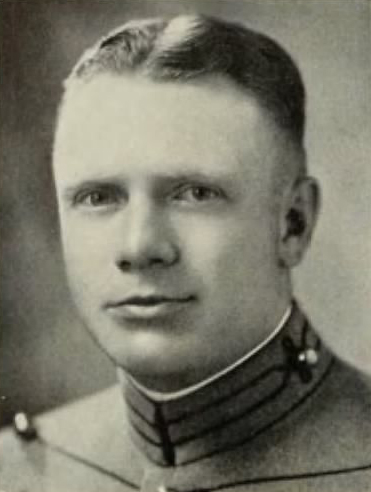
Robert Foster Haggerty is honored on the following 1 monument(s) in our database:
Robert Foster Haggerty was born on September 15, 1904, in Peebles, Adams County, Ohio. He was the son of Robert Fred Haggerty and Mary Maude Miller Haggerty. He was married to Alston Hamilton. He graduated from Fergus County High School in 1922 after completing the four-year scientific course in just three years. He studied electrical engineering at Montana State College and the Montana School of Mines before pursuing a military career, entering West Point in 1926 and graduating in 1930 with a commission in the Coast Artillery Corps. His early service included training in the Air Corps, duty at Fort Kamehameha in Pearl Harbor, and assignments in New York and with the Civilian Conservation Corps.
Demonstrating strong mechanical aptitude, he developed and patented a highly accurate spotting board while stationed at Fort Banks. In 1936, he entered graduate studies at MIT, earning a Master of Science degree in 1937, and continued advanced training at Picatinny Arsenal, Aberdeen Proving Ground, and Frankford Arsenal. In 1939, he returned to the Coast Artillery School at Fort Monroe, graduating early in 1940 as war loomed. That year, he was promoted to Captain and deployed with his family to the Philippines, where he assumed command of Fort Frank on Carabao Island and Battery F, 91st Coast Artillery (Philippine Scouts).
When the Japanese attacked on December 8, 1941, Robert was still commanding the Engineer Depot. Following MacArthur’s order to withdraw to Bataan on December 23, he was promoted to Major and later recalled to Corregidor to help in its final defense with the 91st Coast Artillery. During the month-long siege, he commanded the James Ravine Beach Defense Sector. On April 13, 1942, during a heavy artillery barrage, he volunteered to rescue trapped soldiers in tunnels under enemy fire, personally assisting in their extrication and giving first aid, an act of heroism later officially commended.
After Corregidor’s surrender on May 6, 1942, Robert was taken prisoner and held at PW Camp #1 in Cabanatuan. In the harsh conditions of the camp, he used his ingenuity to improve daily life, crafting tools, furniture, and practical items from scrap materials; he also invented a treadle-operated cigarette machine that became famous in the camp. In October 1944, Robert was moved to Bilibid prison and later forced aboard the Japanese prison ship Oryoku Maru. On December 15, 1944, the ship was bombed by U.S. aircraft in Subic Bay, and Robert was killed while reportedly helping others.
Maj Haggerty's name is memorialized in the Tablets of the Missing in the Manila American Cemetery and Memorial, Manila, Capital District, National Capital Region, Philippines.
Silver Star Citation:
The President of the United States of America, authorized by Act of Congress July 9, 1918, takes pride in presenting the Silver Star (Posthumously) to Major (Coast Artillery Corps) Robert Foster Haggerty (ASN: 0-18085), United States Army, for gallantry in action while serving with the 91st Coast Artillery Regiment, Philippine Scouts, in action against the enemy following a heavy Japanese artillery barrage upon Battery James, Fort Mills, Corregidor, Philippine Islands, on 13 April 1942. When personnel of the battery were trapped as they sought shelter in nearby tunnels, Major Haggerty readily volunteered, although the position was under close enemy observation and steady fire, to rescue his comrades. Disregarding the imminent danger of collapsing walls and roofs, Major Haggerty heroically entered the tunnels, and assisted in extricating soldiers, and gave first aid to the wounded. The gallant actions and dedicated devotion to duty demonstrated by Major Haggerty, without regard for his own life, were in keeping with the highest traditions of military service and reflect great credit upon himself and the United States Army.
Source of information: www.findagrave.com, alumni.westpointaog.org, valor.militarytimes.com