






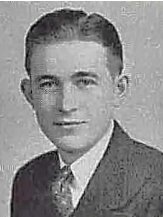
Wayne Matthews Steele is honored on the following 2 monument(s) in our database:
Wayne Matthews Steele was born on May 12, 1919, in New Vienna, Clinton County, Ohio, and was the second son of William Steele and Hattie Regina Morris Steele. He attended the Ohio State University College of Pharmacy, where he was a member of Phi Delta Chi fraternity, graduating in 1941. He subsequently pursued graduate studies at Purdue University, where he also served as a graduate assistant in medicinal chemistry.
On July 17, 1942, Steele enlisted in the United States Army Air Forces and was selected for navigator training. Following the completion of his training, he married Christine M. Boyd and underwent additional training aboard the B-24 Liberator. In March 1944, he was assigned to the 577th Bombardment Squadron, 392nd Bombardment Group (Heavy), of the Eighth Air Force, stationed at RAF Wendling in Norfolk, England. Steele flew his first combat mission on April 1, 1944, and later joined the crew commanded by Second Lieutenant Louis F. Bass aboard the B-24J Liberator Esquire Lady (Serial No. 42-99979).
On April 21, 1944, during what would have been Steele's eighth combat mission, the 392nd Bombardment Group dispatched 28 B-24 Liberators from RAF Wendling at approximately 1:30 PM to bomb an aircraft repair facility at Zwickau, Germany. Steele was serving as navigator aboard Esquire Lady, piloted by Second Lieutenant Louis F. Bass, with Second Lieutenant Kenneth Gahm as co-pilot. The aircraft carried a crew of ten and had previously completed eight missions.
Shortly after takeoff, while the formation was assembling for the mission, weather conditions deteriorated, prompting the recall of the aircraft. During this period, Esquire Lady experienced a catastrophic structural failure when a section of its left wing separated from the fuselage, causing the bomber to roll violently and lose control. Although one account suggests that severe icing conditions may have contributed to the accident, another raises the possibility of a collision with another aircraft. The precise cause of the structural failure remains uncertain.
As the aircraft broke apart, Second Lieutenant Arthur Stover Jr., the bombardier, and Staff Sergeant Gerald Knettel, the flight engineer, were thrown from the fuselage. Both men survived after their parachutes deployed, although Knettel sustained serious injuries. The bomber subsequently crashed in a field near North Tuddenham, Norfolk, England, killing the remaining eight crew members, including Steele. Although the crash occurred before the aircraft reached its intended target and was not directly caused by enemy action, the fatalities were officially classified as killed in action because the crew was participating in a combat mission.
Steele's remains were eventually repatriated to the United States and interred at the New Vienna Independent Order of Odd Fellows (IOOF) Cemetery in New Vienna, Clinton County, Ohio.
Source of information: www.findagrave.com, http://www.2ridetheglobe.com, aihp.org