






The Last Flight of B-24 (42-109830) 'Daisy Mae Scraggs' Information Board
Details:
Next to the rock memorial.
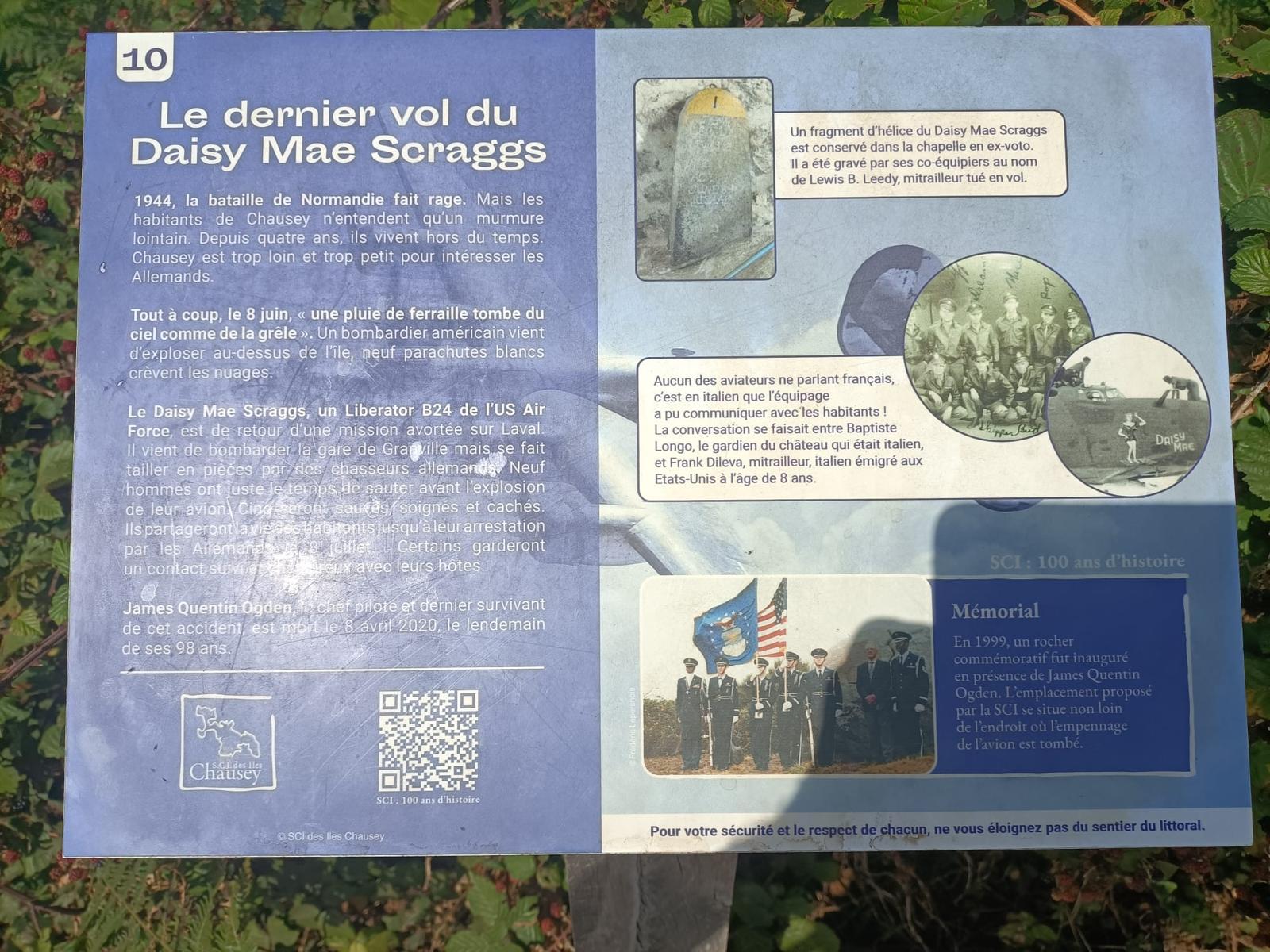
MarkerA freestanding rectangular interpretive information board recounts the story of the American B-24 Liberator Daisy Mae Scraggs (42-109830) and its loss over the Chausey Islands on 8 June 1944. Presented in French, the board features historical accounts alongside wartime photographs of the aircraft and its crew, an image of a preserved propeller fragment commemorating gunner Lewis B. Leedy, and a photograph and description of the memorial inaugurated in 1999 in the presence of pilot and survivor James Quentin Ogden. The propeller fragement is located in the nearby Chapelle Notre-Dame-de-la-Victoire.
Monument Text:
Le dernier vol du Daisy Mae Scraggs
1944, la bataille de Normandie fait rage. Mais les habitants de Chausey n'entendent qu'un murmure lointain. Depuis quatre ans, ils vivent hors du temps. Chausey est trop loin et trop petit pour intéresser les Allemands.
Tout à coup, le 8 juin, « une pluie de ferraille tombe du ciel comme de la grêle ». Un bombardier américain vient
d'exploser au-dessus de l'île, neuf parachutes blancs crèvent les nuages.
Le Daisy Mae Scraggs, un Liberator B24 de l'US Air Force, est de retour d'une mission avortée sur Laval. Il vient de bombarder la gare de Granville mais se fait tailler en pièces par des chasseurs allemands. Neuf hommes ont juste le temps de sauter avant l'explosion de leur avion (cinq seront sauvés, soignés et cachés. Ils partageront la vie des habitants jusqu'à leur arrestation par les Allemands le 8 juillet. Certains garderont un contact suivi jusqu'à leur mort avec leurs hôtes.
James Quentin Odgen, le chef pilote et dernier survivant de cet accident, est mort le 8 avril 2020, le lendemain de ses 98 ans.
Un fragment dhélice du Daisy Mae Scraggs est conservé dans la chapelle en ex-voto. Il a été gravé par ses co-équipiers au nom de Lewis B. Leedy, mitrailleur tué en vol.
Aucun des aviateurs ne parlant français, cest en italien que léquipage a pu communiquer avec les habitants ! La conversation se faisait entre Baptiste Longo, le gardien du château qui était italien, et Frank Dileva, mitrailleur, italien émigré aux Etats-Unis à lâge de 8 ans.
SCI : 100 ans dhistoire
Mémorial
En 1999, un rocher commémoratif fut inauguré en présence de James Quentin Ogden. Lemplacement propose par la SCI se situe non loin de lendroit où lempennage de lavion est tombé.
Pour votre sécurité et le respect de chacun, ne vous éloignez pas du sentier du littoral.
English translation:
The Last Flight of the Daisy Mae Scraggs
In 1944, the Battle of Normandy was raging. But the inhabitants of Chausey heard only a distant murmur. For four years, they had been living apart from the turmoil of the war. Chausey was too remote and too small to be of interest to the Germans.
Suddenly, on June 8, a shower of metal fell from the sky like hail. An American bomber had just exploded above the island, and nine white parachutes pierced through the clouds.
The Daisy Mae Scraggs, a U.S. Air Force B-24 Liberator, was returning from an aborted mission over Laval. It had just bombed the Granville railway station when it was torn apart by German fighters. Nine men barely had time to jump before their aircraft exploded. Five of them were rescued, treated, and hidden. They lived among the islanders until they were arrested by the Germans on July 8. Some remained in regular contact with their hosts until their deaths.
James Quentin Odgen, the chief pilot and last surviving member of the crew involved in the incident, died on April 8, 2020, the day after his 98th birthday.
A fragment of the Daisy Mae Scraggs propeller is preserved in the chapel** as a votive offering. It was engraved by his fellow crew members in memory of Lewis B. Leedy, a gunner who was killed in flight.
Since none of the airmen spoke French, the crew communicated with the inhabitants in Italian! Conversations took place between Baptiste Longo, the castle caretaker, who was Italian, and Frank Dileva, a gunner and Italian immigrant who had moved to the United States at the age of eight.
SCI: 100 Years of History
Memorial
In 1999, a commemorative stone was inaugurated in the presence of James Quentin Ogden. The location proposed by the SCI is situated not far from the place where the aircrafts tail section fell.
For your safety and out of respect for everyone, please stay on the coastal path.
**The nearby Chapelle Notre-Dame-de-la-Victoire
Commemorates:
People:
Units:
446th Bomb Group
704th Bomber Squadron, 446th Bomb Group, Heavy
8th Air Force
French Resistance
Resistance
United States Air Force
United States Army
Wars:
WWII