





RAF Upottery Airfield (USAAF Station 462) History and Layout Information Boards
Details:
Located on either side of the monument.
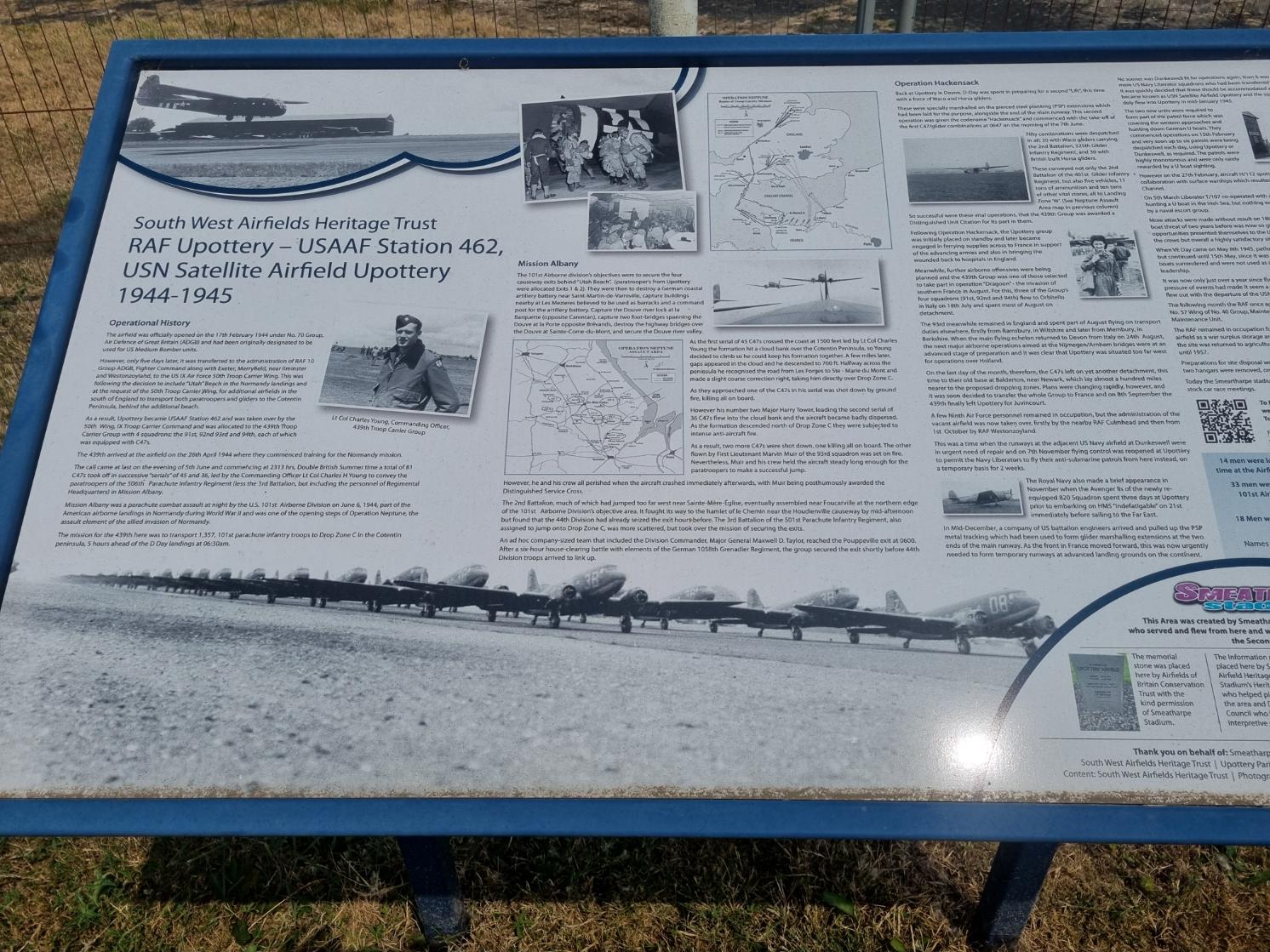
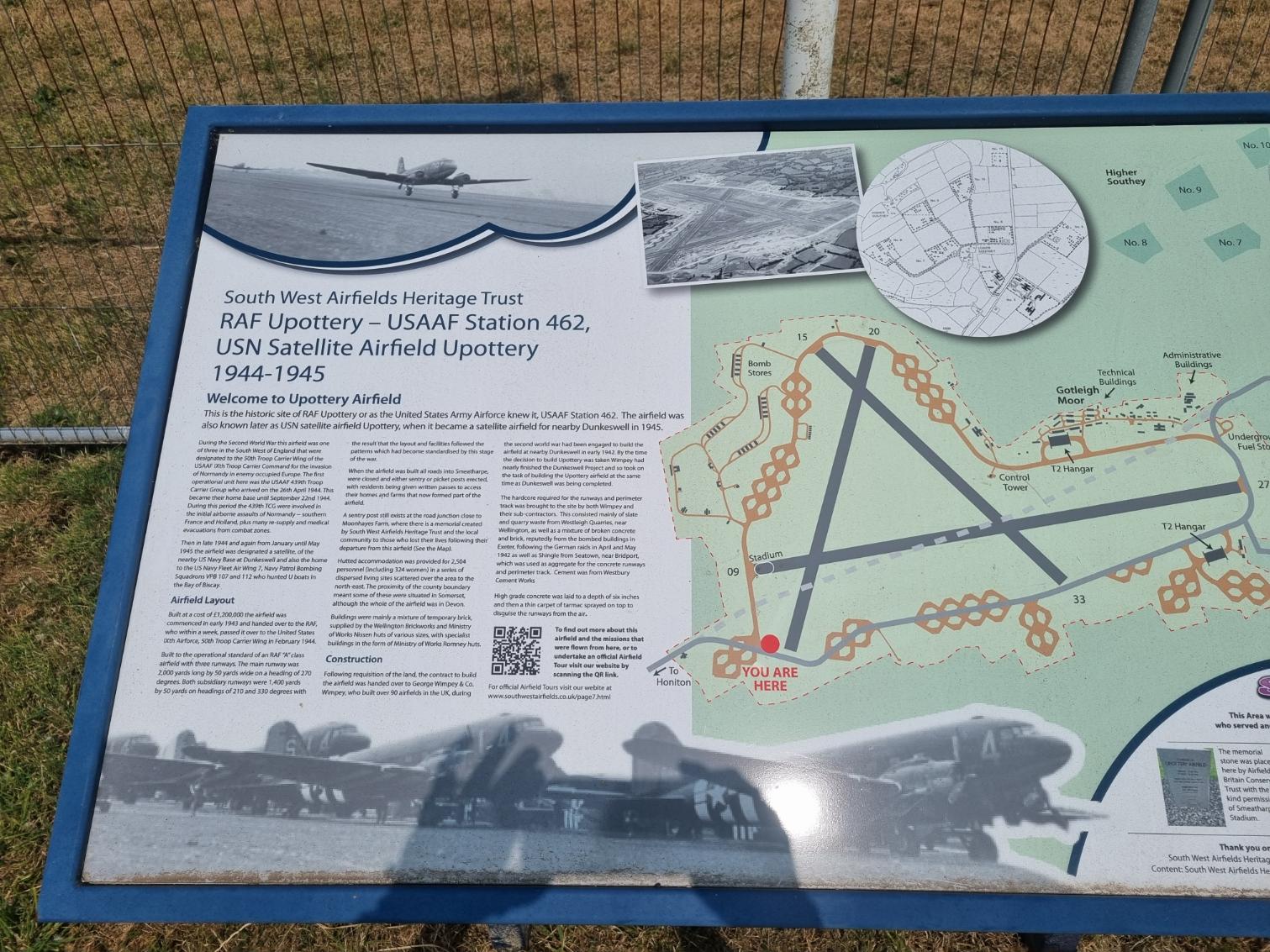
MarkerTwo freestanding interpretive information boards set in blue metal frames present the history of RAF Upottery (USAAF Station 462) and its use by American forces during World War II. Featuring historical narratives, archival photographs, maps, airfield plans, aircraft imagery, and unit illustrations, one board highlights the airfield's wartime history and operations with the U.S. Army Air Forces and U.S. Navy, while the other illustrates the airfield layout, including its runways, hangars, control tower, technical and administrative areas, bomb stores, and other facilities. Both boards were produced by the South West Airfields Heritage Trust.
Monument Text:
Left board text:
South West Airfields Heritage Trust
RAF Upottery USAAF Station 462,
USN Satellite Airfield Upottery
1944-1945
Welcome to Upottery Airfield
This is the historic site of RAF Upottery or as the United States Army Airforce knew it, USAAF Station 462. The airfield was also known later as USN satellite airfield Upottery, when it became a satellite airfield for nearby Dunkeswell in 1945.
During the Second World War this airfield was one of three in the South West of England that were designated to the 50th Troop Carrier Wing of the USAAF IXth Troop Carrier Command for the invasion of Normandy in enemy occupied Europe. The first operational unit here was the USAAF 439th Troop Carrier Group who arrived on the 26th April 1944. This became their home base until September 22nd 1944. During this period the 439th TCG were involved in the initial airborne assaults of Normandy southern France and Holland, plus many re-supply and medical evacuations from combat zones.
Then in late 1944 and again from January until May 1945 the airfield was designated a satellite, of the nearby US Navy Base at Dunkeswell and also the home to the US Navy Fleet Air Wing 7, Navy Patrol Bombing Squadrons VPB 107 and 112 who hunted U boats in the Bay of Biscay.
Airfield Layout
Built at a cost of £1,200,000 the airfield was commenced in early 1943 and handed over to the RAF, who within a week, passed it over to the United States IXth Airforce, 50th Troop Carrier Wing in February 1944.
Built to the operational standard of an RAF "A" class airfield with three runways. The main runway was 2,000 yards long by 50 yards wide on a heading of 270 degrees. Both subsidiary runways were 1,400 yards by 50 yards on headings of 210 and 330 degrees with the result that the layout and facilities followed the patterns which had become standardised by this stage of the war.
When the airfield was built all roads into Smeatharpe, were closed and either sentry or picket posts erected, with residents being given written passes to access their homes and farms that now formed part of the airfield.
A sentry post still exists at the road junction close to Moonhayes Farm, where there is a memorial created by South West Airfields Heritage Trust and the local community to those who lost their lives following their departure from this airfield (See the Map).
Hutted accommodation was provided for 2,504 personnel (including 324 women) in a series of dispersed living sites scattered over the area to the north-east. The proximity of the county boundary meant some of these were situated in Somerset, although the whole of the airfield was in Devon.
Buildings were mainly a mixture of temporary brick, supplied by the Wellington Brickworks and Ministry of Works Nissen huts of various sizes, with specialist buildings in the form of Ministry of Works Romney huts.
Construction
Following requisition of the land, the contract to build the airfield was handed over to George Wimpey & Co. Wimpey, who built over 90 airfields in the UK, during the second world war had been engaged to build the airfield at nearby Dunkeswell in early 1942. By the time the decision to build Upottery was taken Wimpey had nearly finished the Dunkeswell Project and so took on the task of building the Upottery airfield at the same time as Dunkeswell was being completed.
The hardcore required for the runways and perimeter track was brought to the site by both Wimpey and their sub-contractors. This consisted mainly of slate and quarry waste from Westleigh Quarries, near Wellington, as well as a mixture of broken concrete and brick, reputedly from the bombed buildings in Exeter, following the German raids in April and May 1942 as well as Shingle from Seatown, near Bridport, which was used as aggregate for the concrete runways and perimeter track. Cement was from Westbury Cement Works.
High grade concrete was laid to a depth of six inches and then a thin carpet of tarmac sprayed on top to disguise the runways from the air.
Right board text:
South West Airfields Heritage Trust
RAF Upottery USAAF Station 462,
USN Satellite Airfield Upottery
1944-1945
Operational History
The airfield was officially opened on the 17th February 1944 under No. 70 Group, Air Defence of Great Britain (ADGB) and had been originally designated to be used for US Medium Bomber units.
However, only five days later, it was transferred to the administration of RAF 10 Group ADGB, Fighter Command along with Exeter, Merryfield, near Ilminster and Westonzoyland, to the US IX Air Force 50th Troop Carrier Wing. This was following the decision to include "Utah" Beach in the Normandy landings and at the request of the 50th Troop Carrier Wing, for additional airfields in the south of England to transport both paratroopers and gliders to the Cotentin Peninsula, behind the additional beach.
As a result, Upottery became USAAF Station 462 and was taken over by the 50th Wing, IX Troop Carrier Command and was allocated to the 439th Troop Carrier Group with 4 squadrons; the 91st, 92nd 93rd and 94th, each of which was equipped with C47s.
The 439th arrived at the airfield on the 26th April 1944 where they commenced training for the Normandy mission.
The call came at last on the evening of 5th June and commencing at 2313 hrs, Double British Summer time a total of 81 C47s took off in successive "serials" of 45 and 36, led by the Commanding Officer Lt Col Charles H Young to convey the paratroopers of the 506th Parachute Infantry Regiment (less the 3rd Battalion, but including the personnel of Regimental Headquarters) in Mission Albany.
Mission Albany was a parachute combat assault at night by the U.S. 101st. Airborne Division on June 6, 1944, part of the American airborne landings in Normandy during World War II and was one of the opening steps of Operation Neptune, the assault element of the allied invasion of Normandy.
The mission for the 439th here was to transport 1,357, 101st parachute infantry troops to Drop Zone C in the Cotentin Peninsula, 5 hours ahead of the D Day landings at 06:30am.
Mission Albany
The 101st Airborne Division's objectives were to secure the four causeway exits behind "Utah Beach". (paratrooper's from Upottery were allocated exits 1 & 2). They were then to destroy a German coastal artillery battery near Saint-Martin-de-Varreville, capture buildings nearby at Les Mezieres believed to be used as barracks and a command post for the artillery battery. Capture the Douve river lock at la Barquette (opposite Carentan), capture two foot-bridges spanning the Douve at la Porte opposite Brévands, destroy the highway bridges over the Douve at Sainte-Come-du-Mont, and secure the Douve river valley.
As the first serial of 45 C47s crossed the coast at 1500 feet led by Lt Col Charles Young the formation hit a cloud bank over the Cotentin Peninsula, so Young decided to climb so he could keep his formation together. A few miles later, gaps appeared in the cloud and he descended to 700 ft. Halfway across the peninsula he recognised the road from Les Forges to Ste - Marie du Mont and made a slight course correction right, taking him directly over Drop Zone C.
As they approached one of the C47s in his serial was shot down by ground fire, killing all on board.
However his number two Major Harry Tower, leading the second serial of 36 C47s flew into the cloud bank and the aircraft became badly dispersed. As the formation descended north of Drop Zone C they were subjected to intense anti-aircraft fire.
As a result, two more C47s were shot down, one killing all on board. The other flown by First Lieutenant Marvin Muir of the 93rd squadron was set on fire. Nevertheless, Muir and his crew held the aircraft steady long enough for the paratroopers to make a successful jump.
However, he and his crew all perished when the aircraft crashed immediately afterwards, with Muir being posthumously awarded the Distinguished Service Cross.
The 2nd Battalion, much of which had jumped too far west near Sainte-Mère-Eglise, eventually assembled near Foucarville at the northern edge of the 101st Airborne Division's objective area. It fought its way to the hamlet of le Chemin near the Houdienville causeway by mid-afternoon but found that the 4th Division had already seized the exit hours before. The 3rd Battalion of the 501st Parachute Infantry Regiment, also assigned to jump onto Drop Zone C, was more scattered, but took over the mission of securing the exits.
An ad hoc company-sized team that included the Division Commander, Major General Maxwell D. Taylor, reached the Pouppeville exit at 0600. After a six-hour house-clearing battle with elements of the German 1058th Grenadier Regiment, the group secured the exit shortly before 4th Division troops arrived to link up.
Operation Hackensack
Back at Upottery in Devon, D-Day was spent in preparing for a second "Lift", this time the force of Waco and Horsa gliders.
These were specially marshalled on the pierced steel planking (PSP) extensions which had been laid for the purpose, alongside the end of the main runway. This second operation was given the codename "Hackensack" and commenced with the take-off of the first C47/glider combinations at 0647 on the morning of the 7th June.
Fifty combinations were despatched in all; 20 with Waco gliders carrying the 2nd Battalion, 325th Glider Infantry Regiment, and 30 with British built Horsa gliders.
These conveyed not only the 2nd Battalion of the 401st Glider Infantry Regiment, but also five vehicles, 11 tons of ammunition and ten tons of other vital stores, all to Landing Zone 'W'. (See Neptune Assault Area map in previous column)
So successful were these vital operations, that the 439th Group was awarded a Distinguished Unit Citation for its part in them.
Following Operation Hackensack, the Upottery group was initially placed on standby and later became engaged in ferrying supplies across to France in support of the advancing armies and also in bringing the wounded back to hospitals in England.
Meanwhile, further airborne offensives were being planned and the 439th Group was one of those selected to take part in operation "Dragoon" - the invasion of southern France in August. For this, three of the Group's four squadrons (91st, 92nd and 94th) flew to Orbitello in Italy on 18th July and spent most of August on detachment.
The 93rd meanwhile remained in England and spent part of August flying on transport duties elsewhere, firstly from Ramsbury, in Wiltshire and later from Membury, in Berkshire. When the main flying echelon returned to Devon from Italy on 24th August, the next major airborne operations aimed at the Nijmegen/Arnhem bridges were at an advanced stage of preparation and it was clear that Upottery was situated too far west for operations over Holland.
On the last day of the month, therefore, the C47s left on yet another detachment, this time to their old base at Balderton, near Newark, which lay almost a hundred miles nearer to the proposed dropping zones. Plans were changing rapidly, however, and it was soon decided to transfer the whole Group to France and on 8th September the 439th finally left Upottery for Juvincourt.
A few Ninth Air Force personnel remained in occupation, but the administration of the vacant airfield was now taken over, firstly by the nearby RAF Culmhead and then from 1st October by RAF Westonzoyland.
This was a time when the runways at the adjacent US Navy airfield at Dunkeswell were in urgent need of repair and on 7th November flying control was reopened at Upottery to permit the Navy Liberators to fly their anti-submarine patrols from here instead, on a temporary basis for 2 weeks.
The Royal Navy also made a brief appearance in November when the Avenger IIs of the newly re-equipped 820 Squadron spent three days at Upottery prior to embarking on HMS Indefatigable on 21st immediately before sailing to the Far East.
In Mid-December, a company of US battalion engineers arrived and pulled up the PSP metal tracking which had been used to form glider marshalling extensions at the two ends of the main runway. As the front in France moved forward, this was now urgently needed to form temporary runways at advanced landing grounds on the continent.
Commemorates:
People:
Units:
101st Airborne Division
10th Air Force
1st Troop Carrier Squadron
325th Glider Infantry Regiment
401st Glider Infantry Regiment
439th Troop Carrier Group
501st Parachute Infantry Regiment, 101st Airborne Division
506th Parachute Infantry Regiment, 101st Airborne Division
93rd Troop Carrier Squadron, 439th Troop Carrier Group
94th Troop Carrier Squadron, 439th Troop Carrier Group
IX Troop Carrier Command
United States Air Force
United States Army
United States Navy
Wars:
WWII
Battles:
Normandy Invasion
Operation Anvil Dragoon
Operation Neptune
Other images :