





B-17G # 42-3322 ''Full House'' Memorial
Details:
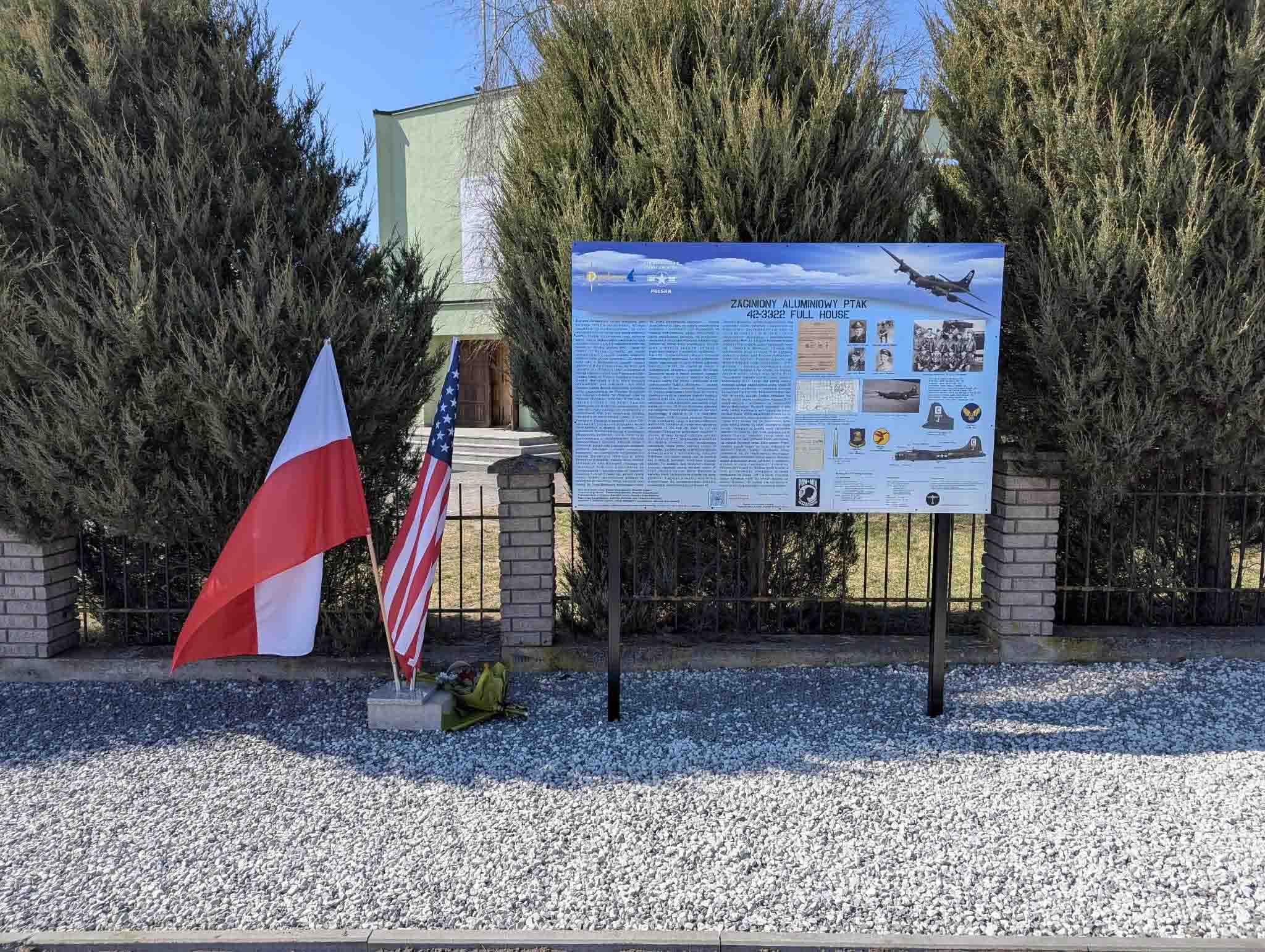
In front of the church gate.
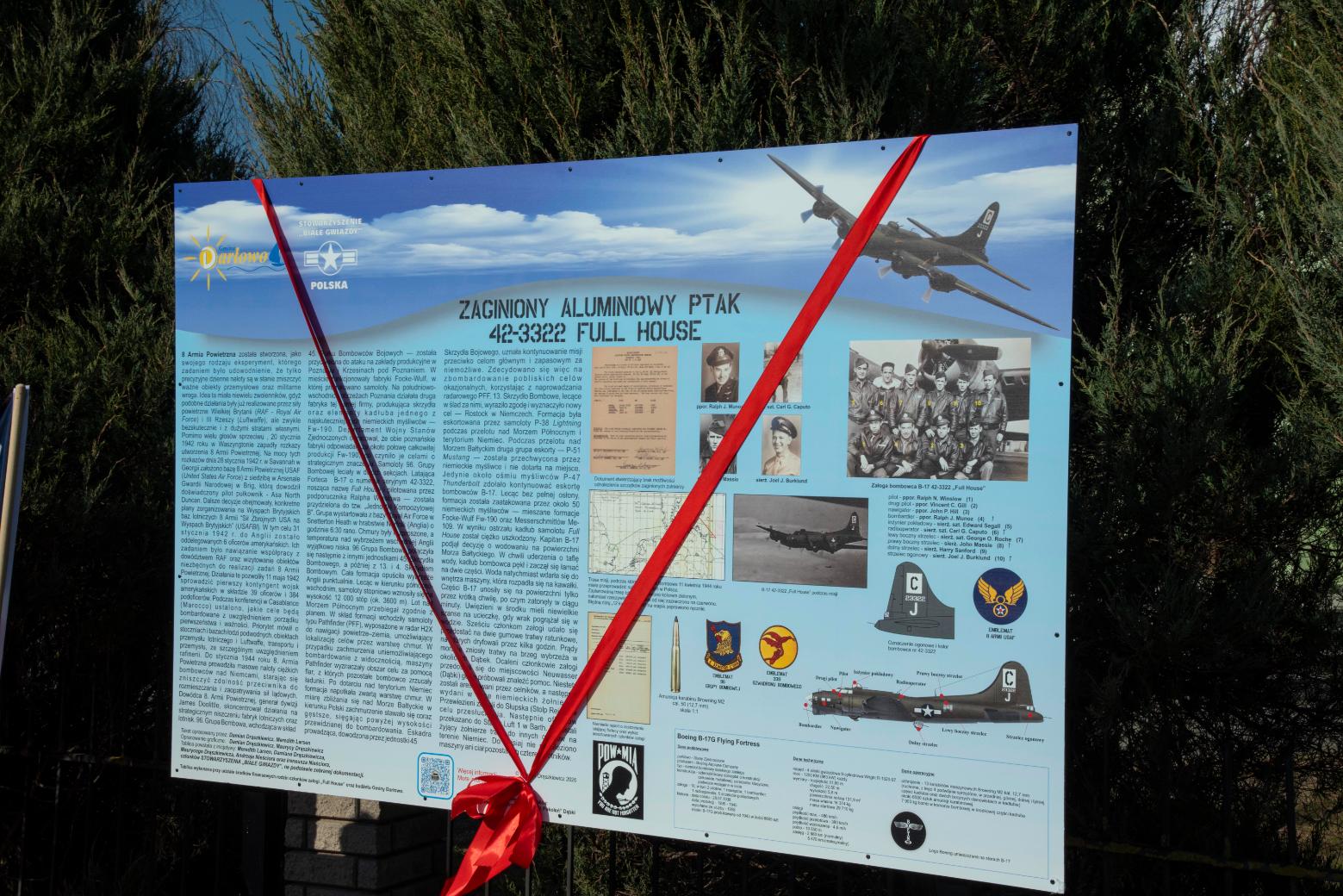
MarkerA rectangular historical memorial and interpretive information board mounted on a metal frame, dedicated to the Boeing B-17G Flying Fortress #42-3322 "Full House" and its crew. During a combat mission in World War II, the aircraft was attacked by German fighter aircraft, forcing it to ditch in the Baltic Sea off the coast near the village of Dbki, Poland. Written in Polish, the board presents the history of the bomber's final mission, photographs, technical specifications of the aircraft, and the names of the crew members. The memorial was officially unveiled on April 11, 2026.
Source of photos: facebook/ Greatest Generation Restoration, Kazimierz Majchrzak, findagrave
Monument Text:
ZAGINIONY ALUMINIOWY PTAK
42-3322 FULL HOUSE
(THE LOST FLYING FORTRESS)
First column text:
8 Armia Powietrzna zostala stworzona, jako swojego rodzaju eksperyment, którego zadaniem bylo udowodnienie, ze tylko precyzyjne dzienne naloty sa w stanie zniszczyc wazne obiekty przemyslowe oraz militarne wroga. Idea ta miala niewielu zwolenników, gdyz podobne dzialania byly juz realizowane przez sily powietrzne Wielkiej Brytanii (RAF Royal Air Force) i III Rzeszy (Luftwaffe), ale zwykle bezskutecznie i z duzymi stratami wlasnymi. Pomimo wielu gosów sprzeciwu, 20 stycznia 1942 roku w Waszyngtonie zapady rozkazy utworzenia 8. Armii Powietrznej. Na mocy tych rozkazów dnia 28 stycznia 1942 r. w Savannah w Georgii zalozono baze 8 Armii Powietrznej USAF (United States Air Force) z siedziba w Arsenale Gwardii Narodowej w Brig, która dowodzil doswiadczony pilot pulkownik Asa North Duncan. Dalsze decyzje obejmoway konkretne plany zorganizowania na Wyspach Brytyjskich baz lotniczych 8 Armii Si Zbrojnych USA na Wyspach Brytyjskich (USAFBI). W tym celu 31 stycznia 1942 r. do Anglii zostao oddelegowanych 6 oficerów amerykaskich. Ich zadaniem bylo nawiazanie wspólpracy z dowództwem RAF oraz wizytowanie obiektów niezbednych do realizacji zadan 8 Armii Powietrznej. Dzialania te pozwolily 11 maja 1942 sprowadzic pierwszy kontyngent wojsk amerykanskich w skladzie 39 oficerów i 384 podoficerów. Podczas konferencji w Casablance (Marocco) ustalono, jakie cele beda bombardowane z uwzglednieniem porzadku pierwszenstwa i waznosci. Priorytet mówil o stoczniach i bazach lodzi podwodnych, obiektach przemyslu lotniczego i Luftwaffe, transportu i przemyslu, ze szczególnym uwzglednieniem rafinerii. Do stycznia 1944 roku 8. Armia Powietrzna prowadzila masowe naloty ciezkich bombowców nad Niemcami, starajac sie zniszczyc zdolnosc przeciwnika do rozmieszczania i zaopatrywania sil ladowych. Dowódca 8. Armii Powietrznej, general dywizji James Doolittle, skoncentrowal dzialania na strategicznym zniszczeniu fabryk lotniczych oraz lotnisk. 96. Grupa Bombowa, wchodzaca w sklad
Second column text:
45. Pulku Bombowców Bojowych zostaa przydzielona do ataku na zakady produkcyjne w Poznaniu i Krzesinach pod Poznaniem. W miecie funkcjonoway fabryki Focke-Wulf, w których produkowano samoloty. Na poudniowo-wschodnich obrzeach Poznania dziaaa druga fabryka tej samej firmy, produkujca skrzyda oraz elementy kaduba jednego z najskuteczniejszych niemieckich myliwców Fw - 190. Departament Wojny Stanów Zjednoczonych oszacowa, e obie poznaskie fabryki odpowiaday za okoo poowy cakowitej produkcji Fw-190, co czynio je celami o strategicznym znaczeniu. Samoloty 96. Grupy bombowe leciay w dwóch sekcjach. Latajca Forteca B-17 o numerze seryjnym 42-3322, noszca nazw Full House, pilotowana przez podporucznika Ralpha Waslowa - zostaa przydzielona do tzw. Jednostki Kompozytowej B. Grupa wystartowaa z bazy Royal Air Force w Snetterton Heath, w hrabstwie Norfolk (Anglia), o godzinie 6:30 rano. Chmury byy rozproszone, a temperatura nad wybrzeem wschodniej Anglii wyjtkowo niska. 96 Grupa Bombowa poczya si nastpnie z innymi jednostkami 45. Skrzyda Bombowego, a póniej z 13. i 4. Skrzydem Bombowym. Caa formacja opuscila wybrzeze Anglii punktualnie. Lecac w kierunku polndeno-wschodnim, samoloty stopniowo wznosily sie na wysokosc 12 000 stóp (ok. 3600 m). Lot nad Morzem Pólnocnym przebiegal zgodnie z planem. W sklad formacji wchodzily samoloty typu Pathfinder (PFF), wyposazone w radar H2X do nawigacji powietrze-ziemia, umozliwiajacy lokalizacje celów przez warstwe chmur. W przypadku zachmurzenia uniemozliwiajacego bombardowanie z widocznoscia, maszyny Pathfinder wyznaczaly obszar celu za pomoca flar, z których pozostale bombowce zrzucaly ladunki. Po dotarciu nad terytorium Niemiec formacja napotkala zwarta warstwe chmur. W miare zblizania sie nad Morze Baltyckie w kierunku Polski zachmurzenie stawalo sie coraz gestsze, siegajac powyzej wysokosci przewidzianej do bombardowania. Eskadra prowadzaca, dowodzona przez jednostki 45
Third column text:
Skrzydla Bojowego, uznala kontynuowanie misji przeciwko celom glównym i zapasowym za niemozliwe. Zdecydowano sie wiec na zbombardowanie pobliskich celów okazjonalnych, korzystajac z naprowadzania radarowego PFF. 13. Skrzydlo Bombowe, lecace w slad za nimi, wyrazilo zgode i wyznaczylo nowy cel Rostock w Niemczech. Formacja byla eskortowana przez samoloty P-38 Lightning podczas przelotu nad Morzem Pólnocnym i terytorium Niemiec. Podczas przelotu nad Morzem Baltyckim druga grupa eskorty P-51 Mustang zostala przechwycona przez niemieckie mysliwce i nie dotarla na miejsce. Jedynie okolo osmiu mysliwców P-47 Thunderbolt zdolalo kontynuowac eskorte bombowców B-17. Lecac bez pelnej oslony, formacja zostala zaatakowana przez okolo 50 niemieckich mysliwców mieszane formacje Focke-Wulf Fw-190 oraz Messerschmittow Me-109. W wyniku ostrzalu kadlub samolotu Full House zostal ciezko uszkodzony. Kapitan B-17 podjal decyzje o wodowaniu na powierzchni Morza Baltyckiego. W chwili uderzenia o tafle wody, kadlub bombowca pekl i zaczal sie lamac na dwie czesci. Woda natychmiast wdarla sie do wnetrza maszyny, która rozpadala sie na kawalki. Czesci B-17 unosily sie na powierzchni tylko przez krótka chwile, po czym zatonely w ciagu minuty. Uwiezieni w srodku mieli niewielkie szanse na ucieczke, gdy wrak pograzal sie w wodzie. Szesciu czlonkom zalogi udalo sie przedostac na dwie gumowe tratwy ratunkowe, na których dryfowali przez kilka godzin. Prady morskie zniosly tratwy na brzeg wybrzeza w okolicach Dabek. Ocaleni czlonkowie zalogi przedostali sie do miejscowosci Neuwasser (Dabki), gdzie próbowali znalezc pomoc. Niestety zostali aresztowani przez celników, a nastpnie wydani w rce niemieckich onierzy. Przewiezieni zostali do Supska (Stolp Reich) w celu przesuchania. Nastpnie jencom przekazano do Stalagu Luft 1 w Barth. Pozostae yjce onierze trafiy do innych obozów na terenie Niemiec. Do dzisiaj nie odnaleziono maszyny ani cia pozostaych czterech lotników.
Fourth column text:
Trasa misji, podczas której 96 Grupa Bombowa 11 kwietnia 1944 roku miaa przeprowadzi nalot na cele w Polsce. Zaplanowan tras lotu oznaczono kolorem zielonym, natomiast rzeczywiste odejcie od niej zaznaczono na czerwono. Bdn dat 12 kwietnia 1944 na mapie poprawiono rcznie.
Fifth column text:
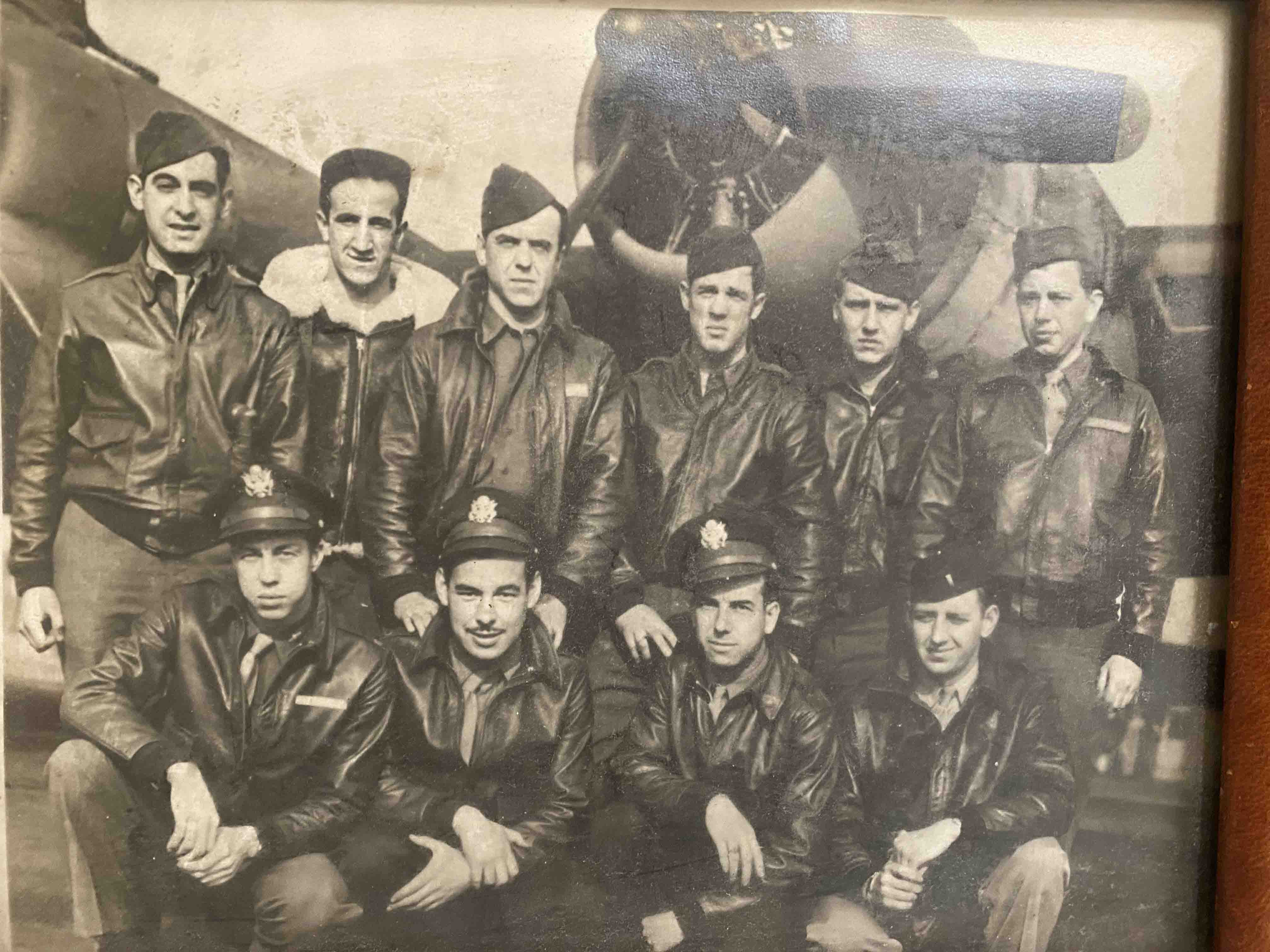
Zaloga bombowca B-17 42-3322 Full House
pilot ppor. Ralph N. Winslow (1)
drugi pilot ppor. Vincent C. Gill (2)
nawigator ppor. John P. Hill (3)
bombardier ppor. Ralph J. Munoz (4)
inzynier pokladowy sierz. szt. Edward Segall (5)
radiooperator sierz. szt. Carl G. Caputo (6)
lewy boczny strzelec sierz. szt. George O. Roche (7)
prawy boczny strzelec sierz. John Massie (8)
dolny strzelec sierz. Harry Sanford (9)
strzelec ogonowy sierz. Joel J. Burklund (10)
Lower column text:
Boeing B-17G Flying Fortress
Dane podstawowe
pastwo: Stany Zjednoczone
producent: Boeing Airplane Company
typ: samolot bombowy dalekiego zasigu
konstrukcja: czterosilnikowy dolnopat o konstrukcji
cakowicie metalowej, usterzenie klasyczne,
podwozie wcigane w locie
Zaloga: 10, w tym 2 pilotów, 1 nawigator, 1 bombardier,
1 radiooperator, 5 strzelców pokladowych
historia - data oblotu 28.07.1938
data produkcji 19391945
wycofanie ze sluzby 1958
model B-17G produkowany od 1943 w ilosci 8685 szt
Dane techniczne
naped - 4 silniki gwiazdowe 9-cylindrowe Wright R-1320-97
moc - 1200 KM (883 kW) kazdy
wymiary - rozpietosc 31,60 m
dlugosc: 22,50 m
wysokosc: 5,8 m
powierzchnia nosna: 131,9 m²
masa wlasna: 16 374 kg
masa startowa: 29 710 kg
osiagi
predkosc max. - 486 km/h
predkosc przelotowa - 380 km/h
predkosc wznoszenia - 4,6 m/s
pulap: 10 850 m
zasieg - 2 980 km (normalny)
5 470 km (maksymalny)
Dane operacyjne
uzbrojenie - 13 karabinów maszynowych Browning M2 kal. 12,7 mm
(ruchome, z tego 4 podwójnie sprzezone, w przedniej, gómej, dolnej i tylniej
czesci kadluba oraz dwoch boczynch stanowiskach w kadlubie)
okolo 6500 sztuk amunicji karabinówej.
7 950 kg bomb w komorze bombowej w srodkowej czesci kadluba
Logo Boeing umieszczane na sterach B-17
English translation:
First third column text:
The Eighth Air Force was created as a kind of experiment whose purpose was to prove that only precision daylight bombing could destroy important enemy industrial and military targets. The idea had few supporters, as similar operations had already been carried out by the air forces of Great Britain (RAF Royal Air Force) and the Third Reich (Luftwaffe), but usually with little success and at great cost to their own forces. Despite many objections, orders to establish the Eighth Air Force were issued in Washington, D.C., on 20 January 1942. Under these orders, on 28 January 1942, the headquarters of the Eighth Air Force of the USAAF (United States Army Air Forces) was established in Savannah, Georgia, at the National Guard Arsenal in Brig, under the command of the experienced pilot Colonel Asa North Duncan. Further decisions focused on plans to organize Eighth Air Force air bases in the British Isles as part of the United States Army Forces in the British Isles (USAFBI). To this end, on 31 January 1942, six American officers were sent to England. Their task was to establish cooperation with the RAF command and inspect facilities required for the operations of the Eighth Air Force. These efforts made it possible, on 11 May 1942, to bring over the first American military contingent consisting of 39 officers and 384 enlisted personnel.
During the Casablanca Conference in Morocco, priorities were established for bombing targets. The highest-priority targets included shipyards and submarine bases, facilities associated with the aircraft industry and the Luftwaffe, transportation infrastructure, and industrial installations, with particular emphasis on oil refineries.
By January 1944, the Eighth Air Force was conducting large-scale heavy bomber raids over Germany in an effort to destroy the enemys ability to deploy and supply its ground forces. The commander of the Eighth Air Force, Major General James Doolittle, concentrated operations on the strategic destruction of aircraft factories and airfields.
The 96th Bomb Group, which was part of the 45th Combat Bombardment Wing, was assigned to attack aircraft production facilities in Pozna and Krzesiny, near Pozna. The city was home to Focke-Wulf factories where aircraft were manufactured. On the southeastern outskirts of Pozna, a second factory operated by the same company produced wings and fuselage components for one of Germany's most effective fighter aircraft, the Fw 190. The United States War Department estimated that the two Pozna factories accounted for approximately half of all Fw 190 production, making them targets of major strategic importance.
Aircraft of the 96th Bomb Group flew in two sections. The B-17 Flying Fortress bearing serial number 42-3322, named Full House and piloted by Second Lieutenant Ralph Winslow, was assigned to the so-called Composite Unit B. The group departed from Royal Air Force Snetterton Heath in Norfolk, England, at 6:30 a.m. The clouds were scattered, and temperatures over England's eastern coast were unusually low. The 96th Bomb Group subsequently joined other units of the 45th Bomb Wing, and later linked up with the 13th and 4th Bomb Wings. The entire formation left the coast of England on schedule. Flying southeastward, the aircraft gradually climbed to an altitude of 12,000 feet (approximately 3,600 meters). The flight across the North Sea proceeded according to plan. Included in the formation were Pathfinder (PFF) aircraft equipped with H2X radar for air-to-ground navigation, enabling target identification through cloud cover. When weather conditions prevented visual bombing, the Pathfinder aircraft marked the target area with flares, allowing the remaining bombers to release their bomb loads accurately.
Upon reaching German airspace, the formation encountered a solid layer of clouds. As it approached the Baltic Sea en route to Poland, the cloud cover became increasingly dense, extending above the planned bombing altitude.
The lead squadron of the 45th Bomb Wing determined that continuing the mission against either the primary or alternate targets was impossible. It was therefore decided to bomb nearby targets of opportunity, using Pathfinder (PFF) radar guidance.
The 13th Bomb Wing, flying behind them, agreed with the decision and designated a new target: Rostock, Germany.
The formation was escorted by P-38 Lightning fighters during its flight over the North Sea and German territory. However, while crossing the Baltic Sea, the second escort groupP-51 Mustangswas intercepted by German fighters and failed to reach the bombers. Only about eight P-47 Thunderbolt fighters were able to continue escorting the B-17 formation. Flying without full fighter protection, the formation was attacked by approximately 50 German fighters, consisting of mixed formations of Focke-Wulf Fw 190s and Messerschmitt Bf 109s. As a result of the attack, the fuselage of the Full House was severely damaged. The pilot of the B-17 decided to ditch the aircraft in the Baltic Sea. Upon striking the water, the bomber's fuselage cracked and began breaking into two sections. Water immediately flooded the aircraft as it disintegrated. Pieces of the B-17 remained afloat only briefly before sinking within a minute. Those trapped inside had little chance of escape as the wreck disappeared beneath the water. Six crew members managed to reach two inflatable life rafts and drifted at sea for several hours.
Ocean currents eventually carried the rafts ashore near Dbki. The surviving crew members made their way to the village of Neuwasser (modern-day Dbki), where they attempted to seek help. Unfortunately, they were arrested by customs officials and subsequently handed over to German soldiers. The airmen were transported to Stolp (present-day Supsk) for interrogation and were later transferred to Stalag Luft I in Barth. Other surviving crew members were sent to various prisoner-of-war camps throughout Germany. To this day, neither the aircraft nor the bodies of the remaining four airmen have been recovered.
Fourth column text:
Mission route of the 96th Bomb Group during its bombing mission against targets in Poland on April 11, 1944. The planned flight route is shown in green, while the actual deviation from that route is marked in red. The incorrect date "April 12, 1944" shown on the map was corrected by hand.
Fifth column text:
Crew of B-17 42-3322 "Full House"
Pilot 2nd Lt. Ralph N. Winslow (1)
Co-pilot 2nd Lt. Vincent C. Gill (2)
Navigator 2nd Lt. John P. Hill (3)
Bombardier 2nd Lt. Ralph J. Munoz (4)
Flight Engineer Staff Sgt. Edward Segall (5)
Radio Operator Staff Sgt. Carl G. Caputo (6)
Left Waist Gunner Staff Sgt. George O. Roche (7)
Right Waist Gunner Sgt. John Massie (8)
Ball Turret Gunner Sgt. Harry Sanford (9)
Tail Gunner Sgt. Joel J. Burklund (10)
Lower column text:
Boeing B-17G Flying Fortress
General Information
Country of Origin: United States
Manufacturer: Boeing Airplane Company
Type: Long-range heavy bomber
Design: Four-engine, all-metal low-wing monoplane
with conventional tail assembly and retractable landing gear
Crew: 10 personnel, consisting of: 2 pilots, 1 navigator, 1 bombardier
1 radio operator, 5 aerial gunners
History: First Flight: July 28, 1938
Production Period: 19391945
Retired from Service: 1958
B-17G Variant: Produced from 1943 onward; 8,685 aircraft built
Technical Specifications
Powerplant - Four Wright R-1820-97 nine-cylinder radial engines
Power Output - 1,200 horsepower (883 kW) each
Dimensions - Wingspan: 31.60 m (103 ft 8 in)
Length: 22.50 m (73 ft 10 in)
Height: 5.8 m (19 ft)
Wing Area: 131.9 m² (1,420 sq ft)
Weights - Empty Weight: 16,374 kg (36,099 lb)
Maximum Takeoff Weight: 29,710 kg (65,500 lb)
Performance
Maximum Speed: 486 km/h (302 mph)
Cruising Speed: 380 km/h (236 mph)
Rate of Climb: 4.6 m/s (900 ft/min)
Service Ceiling: 10,850 m (35,600 ft)
Range - 2,980 km (1,850 mi) normal
5,470 km (3,400 mi) maximum
Operational Data
Armament - 13 Browning M2 .50-caliber (12.7 mm) machine guns
(mounted in multiple positions throughout the aircraft, including:
Nose, Upper fuselage , Lower fuselage , Tail section , Two waist gun positions )
Approximately 6,500 rounds of ammunition Bomb Load
Up to 7,950 kg (17,500 lb) of bombs carried in the bomb bay located in the center fuselage
Boeing logo as displayed on the tail surfaces of B-17 aircraft.
Commemorates:
People:
James Harold 'Jimmy' Doolittle
Units:
339th Bomber Squadron, 96th Bomber Group
4th Bomber Wing, 8th Air Force
8th Air Force
96th Bomber Group
United States Air Force
Wars:
WWII
Other images :