





'Damn Yankee' B-17 (41-24557) Crash Memorial Panel
Details:
Next to the plaque.
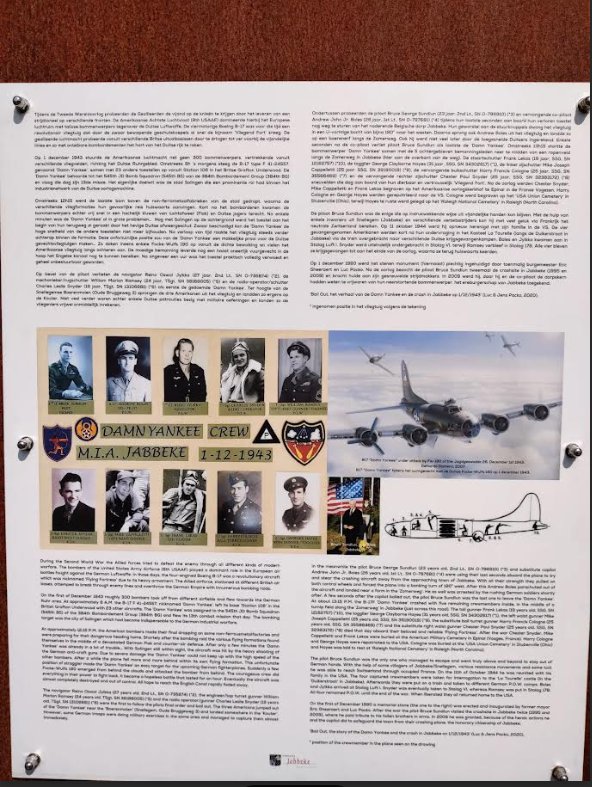
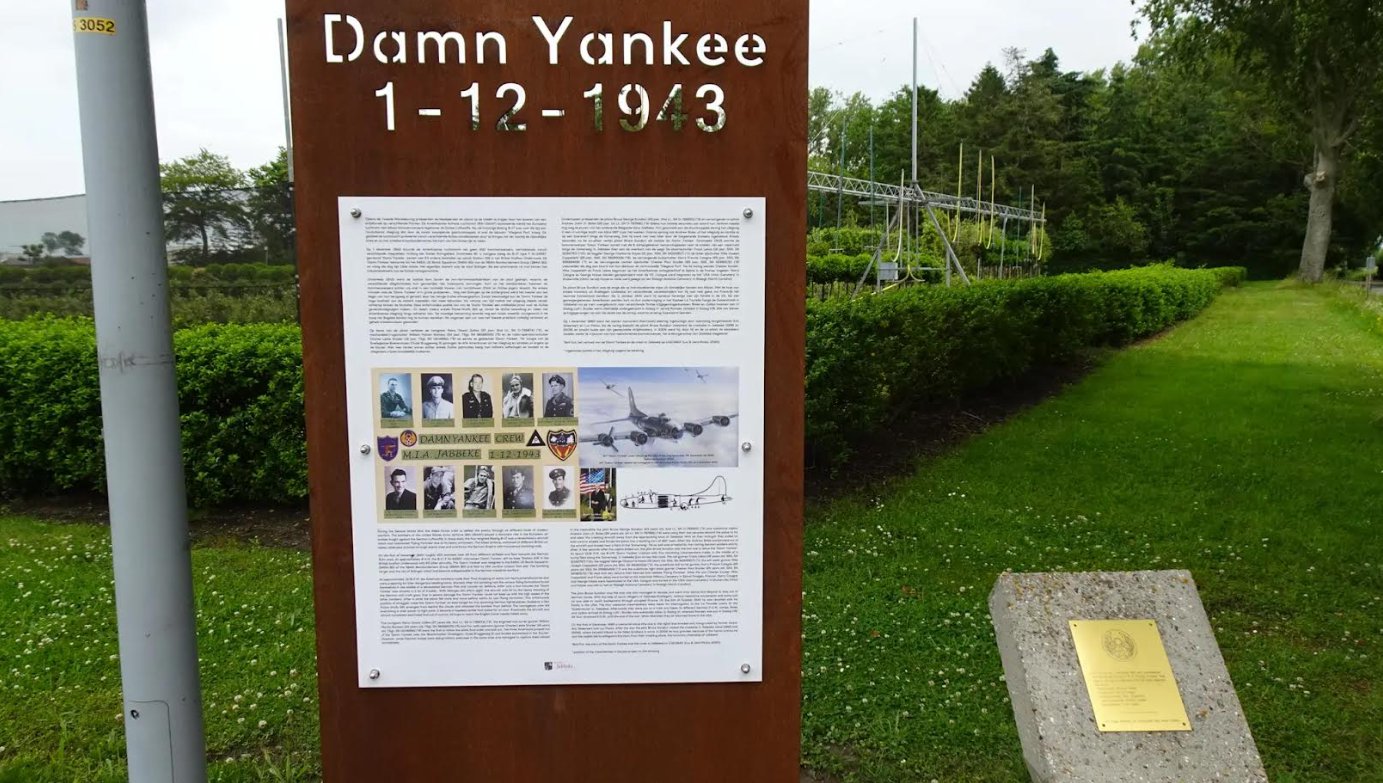
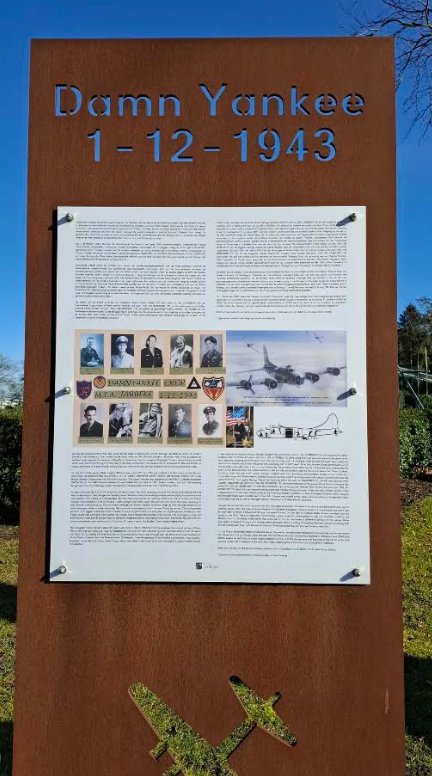
MarkerA tall, freestanding memorial panel made of weathered steel features a large rectangular information board in both Dutch and English, detailing the history and mission of the B-17 Damn Yankee. At the center is a row of small portrait photographs of the crew members, accompanied by their names and insignias. At the bottom of the structure is a cut-out silhouette of a B-17 aircraft.
Source of photo: www.findagrave.com
Monument Text:
Damn Yankee
1 12 1943
First Column text:
Tijdens de Tweede Wereldoorlog probeerden de Geallieerden de vijand op de knieën te krijgen door het leveren van een strijdtoneel op verschillende fronten. De Amerikaanse Achtste Luchtvloot (8th USAAF) domineerde hierbij het Europese luchtruim met talloze bommenwerpers tegenover de Duitse Luftwaffe. De viermotorige Boeing B-17 was voor die tijd een revolutionair vliegtuig dat door de zwaar bewapende geschutskoepels al snel de bijnaam Vliegend Fort kreeg. De geallieerde luchtmacht probeerde vanuit verschillende Britse uitvalbasissen door te dringen tot ver voorbij de vijandelijke linies en zo met ontelbare bombardementen het hart van het Duitse rijk te raken.
Op 1 december 1943 stuurde de Amerikaanse luchtmacht net geen 300 bommenwerpers, vertrekkende vanuit verschillende vliegvelden, richting het Duitse Ruhrgebied. Omstreeks 8h s morgens steeg de B-17 type F 41-24557, genaamd Damn Yankee, samen met 23 andere toestellen op vanuit Station 106 in het Britse Grafton Underwood. De Damn Yankee behoorde tot het 545th JD Bomb Squadron (545th BS) van de 384th Bombardement Group (384th BG) en vloog die dag zijn 13de missie. Het eigenlijke doelwit was de stad Solingen die een prominente rol had binnen het industrienetwerk van de Duitse oorlogsmachine.
Omstreeks 12h15 werd de laatste bom boven de non-ferrometaalfabrieken van de stad gedropt, waarna de verschillende vliegformaties hun gevaarlijke reis huiswaarts aanvingen. Kort na het bombarderen kwamen de bommenwerpers echter vrij snel in een hachelijk kluwen van luchtafweer (Flak) en Duitse jagers terecht. Na enkele minuten was de Damn Yankee al in grote problemen... Nog met Solingen op de achtergrond werd het toestel aan het begin van hun terugweg al geraakt door het hevige Duitse afweergeschut. Zwaar beschadigd kon de Damn Yankee de hoge snelheid van de andere toestellen niet meer bijhouden. Na verloop van tijd raakte het vliegtuig steeds verder achterop binnen de formatie. Deze onfortuinlijke positie zou van de Damn Yankee een makkelijke prooi voor de Duitse gevechtsvliegtuigen maken. Zo doken ineens enkele Focke-Wulfs 190 op vanuit de dichte bewolking en vielen het Amerikaanse vliegtuig langs achteren aan. De moedige bemanning leverde nog een haast oneerlijk vuurgevecht in de hoop het Engelse kanaal nog te kunnen bereiken. Na ongeveer een uur was het toestel praktisch volledig verwoest en geheel onbestuurbaar geworden.
Op bevel van de piloot verlieten de navigator Reino Oswal Jylkka (27 jaar, 2nd Lt., SN O-735874) (*2), de mechanieker/rugschutter William Marlon Ramsey (24 jaar, TSgt, SN 38188005) (*5) en de radio-operator/schutter Charles Leslie Snyder (19 jaar, TSgt, SN 13106881) (*6) als eerste de gedoemde Damn Yankee. Ter hoogte van de Snellegemse Boerenmolen (Oude Brugseweg 3) sprongen de drie Amerikanen uit het vliegtuig en landden zo ergens op de Kouter. Niet veel verder waren echter enkele Duitse patrouilles bezig met militaire oefeningen en konden zo de vliegeniers vrijwel onmiddellijk inrekenen.
During the Second World War the Allied forces tried to defeat the enemy through all different kinds of modern warfare. The bombers of the United States Army Airforce (8th USAAF) played a dominant role in the European air battles fought against the German Luftwaffe. In those days, the four-engined Boeing B-17 was a revolutionary aircraft which was nicknamed Flying Fortress due to its heavy armament. The Allied airforce, stationed at different British air bases, attempted to break through enemy lines and overthrow the German Empire with innumerous bombing raids.
On the first of December 1943 roughly 300 bombers took off from different airfields and flew towards the German Ruhr area. At approximately 8 AM, the B-17 F 41-24557, nicknamed Damn Yankee, left its base Station 106 in the British Grafton Underwood with 23 other aircrafts. The Damn Yankee was assigned to the 545th JD Bomb Squadron (545th BS) of the 384th Bombardment Group (384th BG) and flew its 13th combat mission that day. The bombing target was the city of Solingen which had become indispensable to the German industrial warfare.
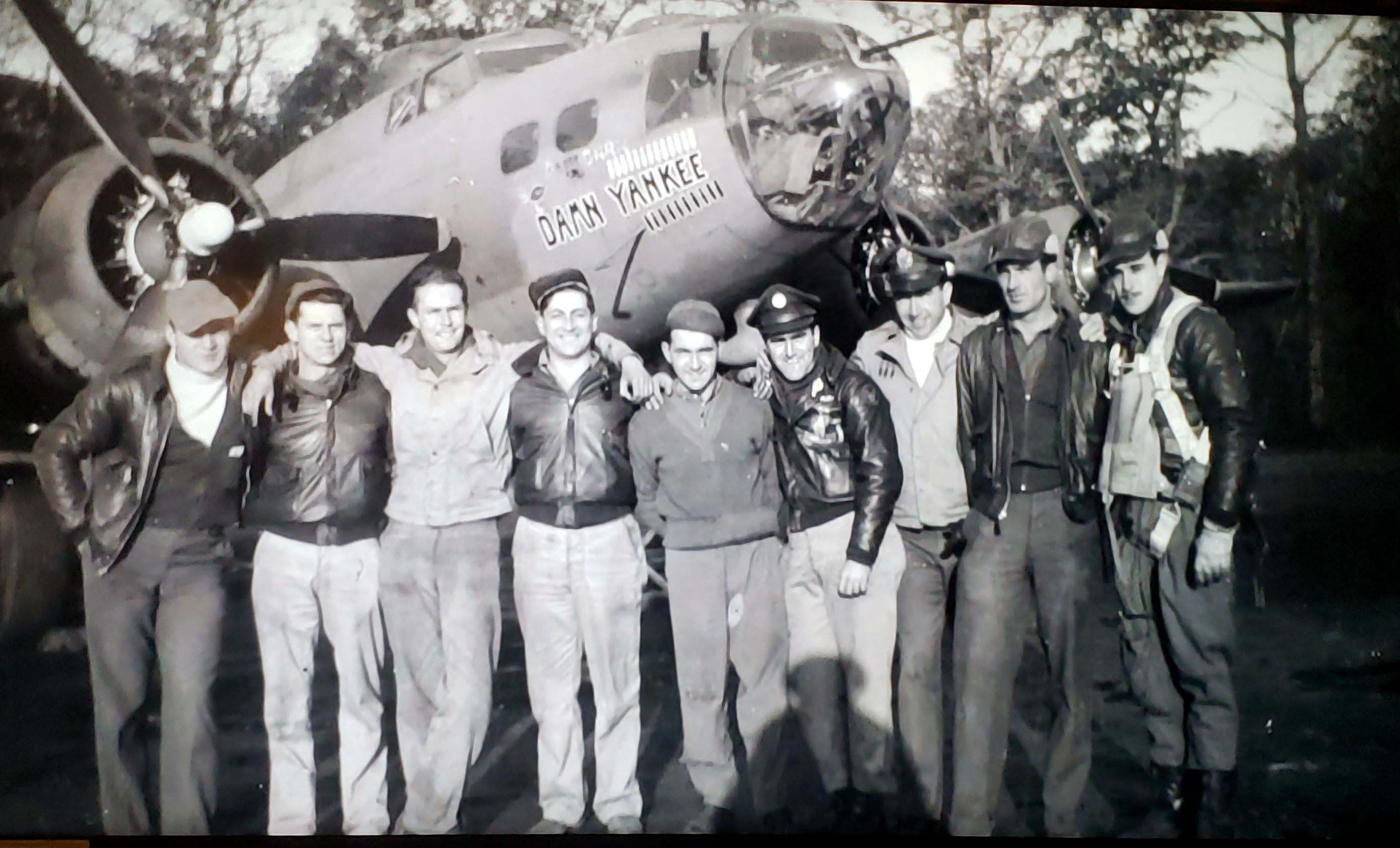
At approximately 12:15 P.M., the American bombers made their final dropping on some non-ferrous metal factories and were preparing for their dangerous heading home. Shortly after the bombing raid the various flying formations found themselves in the middle of a devastated German Flak and counter-air defence. After only a few minutes the Damn Yankee was already in a lot of trouble. With Solingen still within sight, the aircraft was hit by heavy shooting of the German anti-air guns. Due to severe damage the Damn Yankee could not keep up with the high speed of the other bombers. After a while the plane fell more and more behind within its own flying formation. This unfortunate position of straggler made the Damn Yankee an easy target for the upcoming German fighterplanes. Suddenly a few Focke-Wulfs 190 emerged from behind the clouds and attacked the bomber from behind. The courageous crew did everything in their power to fight back. It became a hopeless battle that lasted for an hour. Eventually the aircraft was almost completely destroyed and out of control. All hope to reach the English Canal rapidly faded away.
The navigator Reino Oswal Jylkka (27 years old, 2nd Lt., SN O-735874) (*2), the engineer/top turret gunner William Marion Ramsey (24 years old, TSgt, SN 38188005) (*5) and the radio operator/gunner Charles Leslie Snyder (19 years old, TSgt, SN 13106881) (*6) were the first to follow the pilots final order and bail out. The three Americans jumped out of the Damn Yankee near the Boerenmolen (Snellegem, Oude Brugseweg 3) and landed somewhere in the Kouter. However, some German troops were doing military exercises in the same area and managed to capture them almost immediately.
Second Column text:
Ondertussen probeerden de piloot Bruce George Sundlun (23 jaar, 2nd Lt., SN O-796910) (*3) en vervangende co-piloot Andrew John Jr. Boles (26 jaar, 1st Lt., SN O-797681) (*4) tijdens hun laatste seconden aan boord hun verloren toestel nog weg te sturen van het naderende Belgische dorp Jabbeke. Hun geworstel aan de stuurknuppels dwong het vliegtuig in een U-vormige bocht van bijna 180° naar het westen. Daarna sprong ook Andrew Boles uit het vliegtuig en landde zo op een boerenerf langs de Zomerweg. Ook hij werd niet veel later door de toegesnelde Duitsers ingerekend. Enkele seconden na de co-piloot verliet piloot Bruce Sundlun als laatste de Damn Yankee. Omstreeks 13h15 stortte de bommenwerper Damn Yankee samen met de 5 achtergebleven bemanningsleden neer te midden van een rapenveld langs de Zomerweg in Jabbeke (hier aan de overkant van de weg). De staartschutter Frank Lekas (19 jaar, SSG, SN 12162757) (*10), de togglier George Clayborne Hayes (31 jaar, SSG, SN 34302617) (*1), de linker zijschutter Mike Joseph Cappelletti (25 jaar, SSG, SN 39190019) (*9), de vervangende buikschutter Harry Francis Cologne (25 jaar, SSG, SN 35586469) (*7) en de vervangende rechter zijschutter Chester Paul Snyder (25 jaar, SSG, SN 32383172) (*8) sneuvelden die dag aan boord van hun dierbaar en vertrouwellijk Vliegend Fort. Na de oorlog werden Chester Snyder, Mike Cappelletti en Frank Lekas begraven op het Amerikaanse oorlogskerkhof te Epinal in de Franse Vogezen. Harry Cologne en George Hayes werden gerepatrieerd naar de VS. Cologne werd begraven op het USA Union Cemetery in Stubenville (Ohio), terwijl Hayes te ruste werd gelegd op het Raleigh National Cemetery in Raleigh (North Carolina).
De piloot Bruce Sundlun was de enige die op indrukwekkende wijze uit vijandelijke handen kon blijven. Met de hulp van enkele inwoners uit Snellegem (Jabbeke) en verschillende verzetsstrijders kon hij met veel geluk via Frankrijk het neutrale Zwitserland bereiken. Op 11 oktober 1944 werd hij opnieuw herenigd met zijn familie in de VS. De vier gevangengenomen Amerikanen werden na kort na hun ondervraging in het Kasteel La Tourelle (langs de Duikerstraat in Jabbeke) via de trein overgebracht naar verschillende Duitse krijgsgevangenkampen. Boles en Jylkka kwamen aan in Stalag Luft I. Snyder werd uiteindelijk ondergebracht in Stalag IV, terwijl Ramsey verbleef in Stalag 17B. Alle vier bleven ze krijgsgevangen tot aan het einde van de oorlog, waarna ze terug huiswaarts keerden.
Op 1 december 1990 werd het stenen monument (hiernaast) plechtig ingehuldigd door toenmalig burgemeester Eric Gheerart en Luc Packo. Na de oorlog bezocht de piloot Bruce Sundlun tweemaal de crashsite in Jabbeke (1995 en 2009) en bracht hulde aan zijn gesneuvelde strijdmakkers. In 2009 werd hij, daar hij en de co-piloot de dorpskern hadden weten te vrijwaren van hun neerstortende bommenwerper, het ereburgerschap van Jabbeke toegekend.
Bail Out, het verhaal van de Damn Yankee en de crash in Jabbeke op 1/12/1943 (Luc & Jens Packo, 2020).
* Ingenomen positie in het vliegtuig volgens de tekening
In the meanwhile the pilot Bruce George Sundlun (23 years old, 2nd Lt., SN O-796910) (*3) and substitute copilot Andrew John Jr. Boles (26 years old, 1st Lt., SN O-797681) (*4) were using their last seconds aboard the plane to try and stear the crashing plane away from the approaching town of Jabbeke. With all their strength they pulled on both control wheels and forced the plane into a banking turn of 180° west. After this Andrew Boles parachuted out of the aircraft and landed near a farm in the Zomerweg. He as well was arrested by the rushing German soldiers shortly after. A few seconds after the copilot bailed out, the pilot Bruce Sundlun was the last one to leave the Damn Yankee. At about 13:15 P.M. the B-17 Damn Yankee crashed with five remaining crew members inside, in the middle of a turnip field along the Zomerweg in Jabbeke (just across this road). The tail gunner Frank Lekas (19 years old, SSG, SN 12162757) (*10), the togglier Clayborne Hayes (31 years old, SSG, SN 34302617) (*1), the left waist gunner Mike Joseph Cappelletti (25 years old, SSG, SN 39190019) (*9), the substitute ball turret gunner Harry Francis Cologne (25 years old, SSG, SN 35586469) (*7) and the substitute right waist gunner Chester Paul Snyder (25 years old, SSG, SN 32383172) (*8) died that day aboard their beloved and reliable Flying Fortress. After the war Chester Snyder, Mike Cappelletti and Frank Lekas were buried at the American Military Cemetery in Epinal (Vosges, France). Harry Cologne and George Hayes were repatriated to the USA. Cologne was buried at the USA Union Cemetery in Stubenville (Ohio) and Hayes was laid to rest at Raleigh National Cemetery in Raleigh (North Carolina).
The pilot Bruce Sundlun was the only one who managed to escape and went truly above and beyond to stay out of German hands. With the help of some villagers of Jabbeke/Snellegem, various resistance movements and some luck he was able to reach Switzerland through occupied France. On the 11th of October 1944 he was reunited with his family in the USA. The four captured crewmembers were taken for interrogation to the La Tourelle castle (in the 'Dulkerstraat' in Jabbeke). Afterwards they were put on a train and taken to different German P.O.W. camps. Boles and Jylkka arrived at Stalag Luft I. Snyder was eventually taken to Stalag VI, whereas Ramsey was put in Stalag 17B. All four remained P.O.W. until the end of the war. When liberated they all returned home to the USA.
On the first of December 1990 a memorial stone (the one to the right) was erected and inaugurated by former mayor Eric Gheeroert and Luc Packo. After the war the pilot Bruce Sundlun visited the crashsite in Jabbeke twice (1995 and 2009), where he paid tribute to his fallen brothers in arms. In 2009 he was granted, because of the heroic actions he and the copilot did to safeguard the town from their crashing plane, the honorary citizenship of Jabbeke.
Bail Out, the story of the Damn Yankee and the crash in Jabbeke on 1/12/1943 (Luc & Jens Packo, 2020).
*position of the crewmember in the plane seen on the drawing
Commemorates:
People:
Units:
384th Bomb Group (Heavy)
545th Bomber Squadron, 384th Bomb Group, Heavy
8th Air Force
French Resistance
Resistance
United States Air Force
United States Army
Wars:
WWII
Other images :