





AEF Logistics Base 'Camp Williams' Information Board
Details:
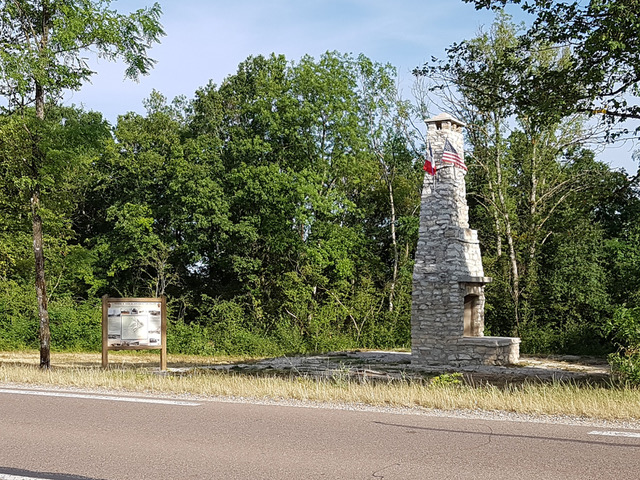
Next to the chimney.
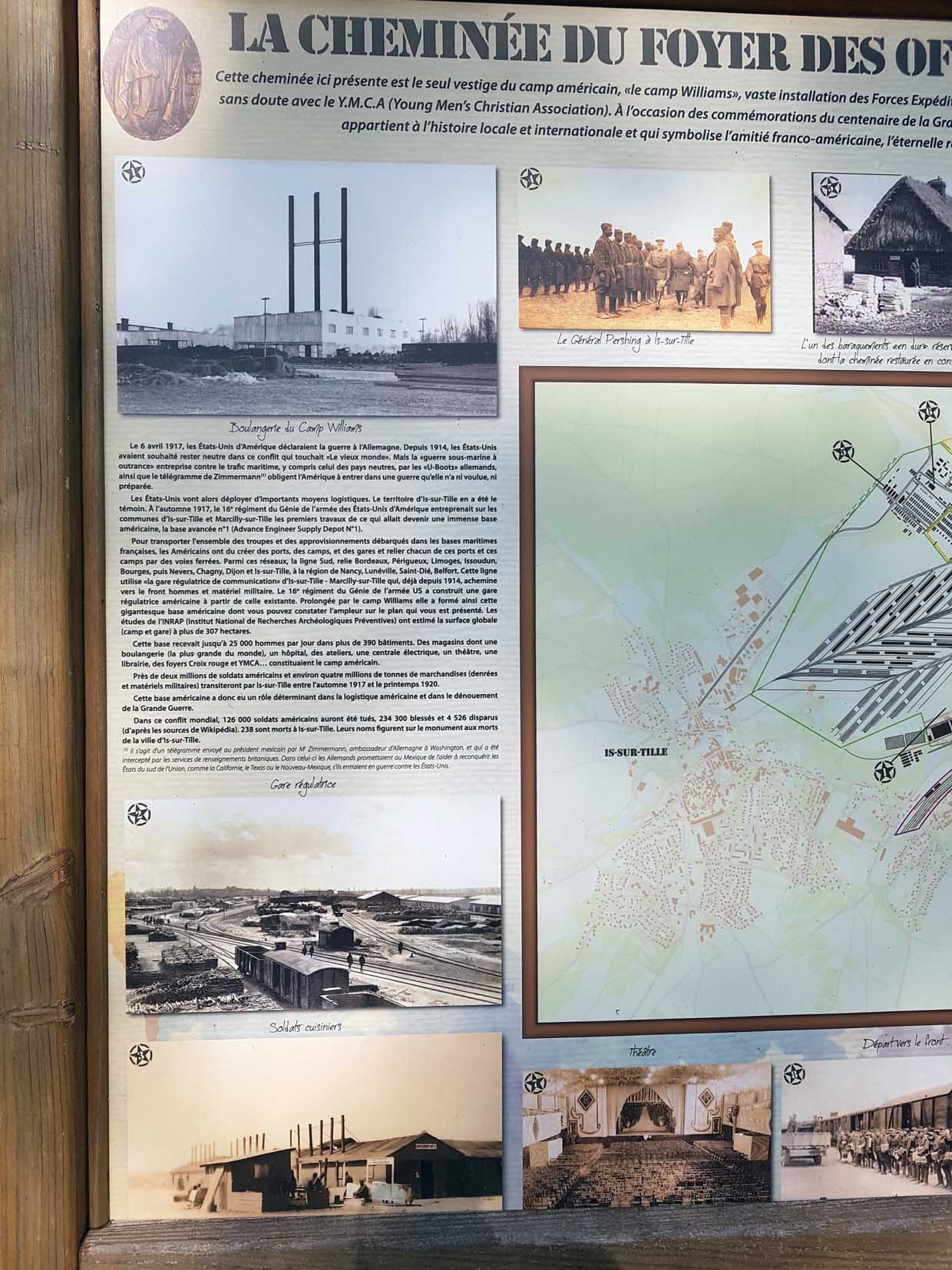
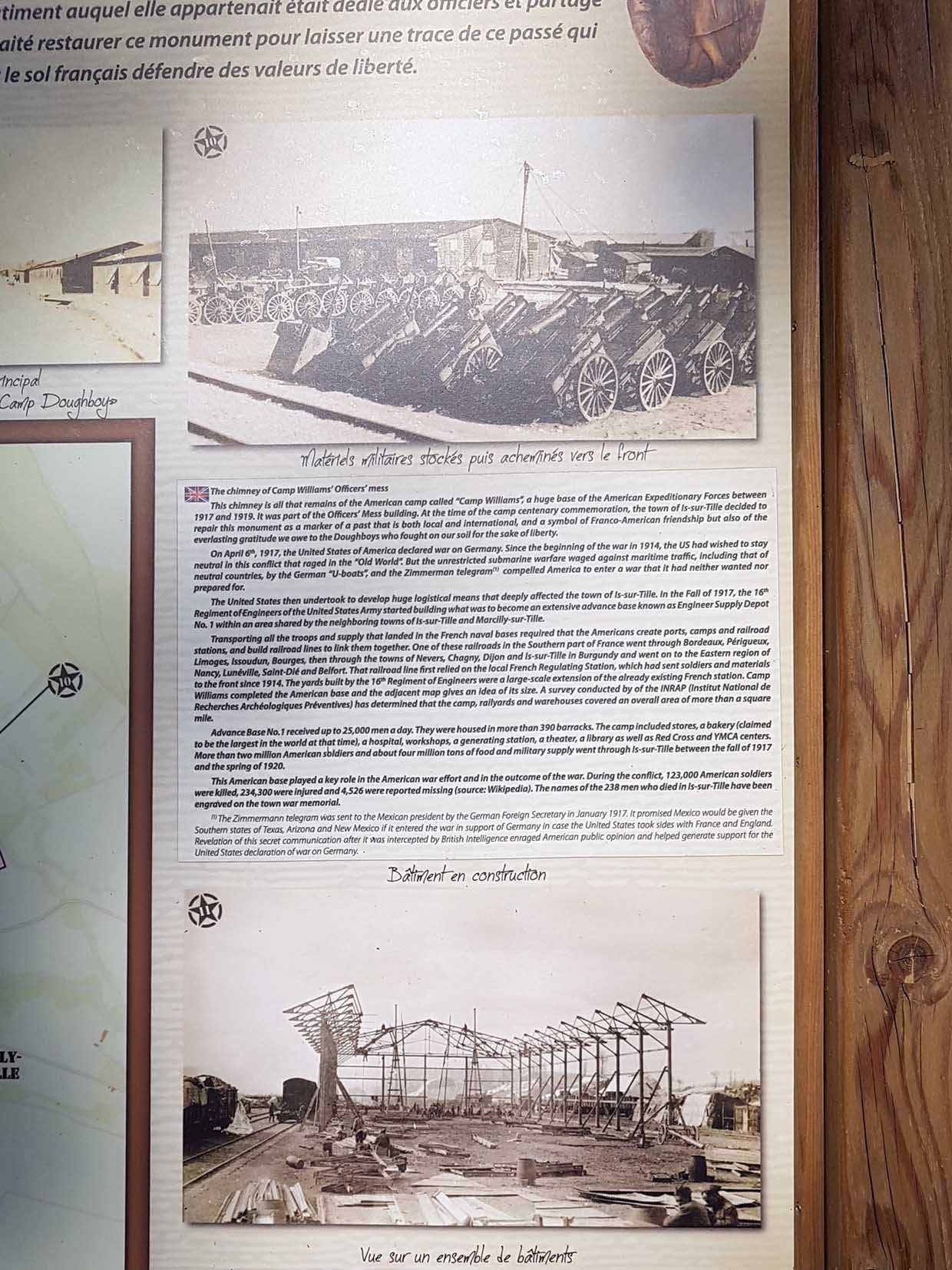
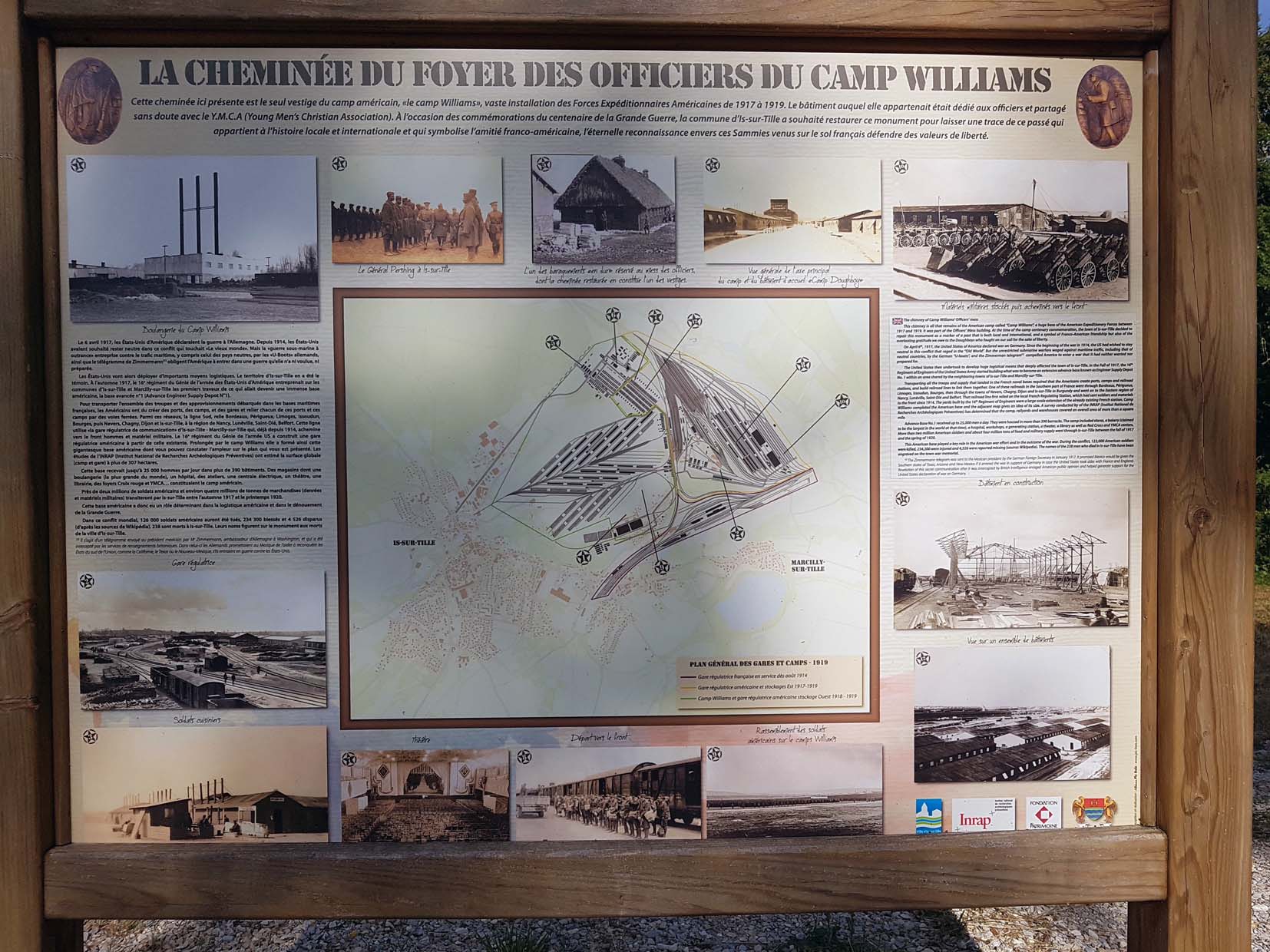
MarkerA rectangular wooden information board featuring historical photographs, bilingual explanatory text panels in French and English, and a central site map depicting the layout of the former camp and the location of the chimney. The information sign commemorates Camp Williams, also known as Advanced Base No. 1, which served as a large forward logistics base supporting the American Expeditionary Forces (AEF) in France during World War I.
Special thanks to the Société d'histoire Tille/Ignon (SHTI) for assistance with this memorial.
Monument Text:
LA CHEMINÉE DU FOYER DES OFFICIERS DU CAMP WILLIAMS
Cette cheminée ici présente est le seul vestige du camp américain, «le camp Williams», vaste installation des Forces Expéditionnaires Américaines de 1917 à 1919. Le bâtiment auquel elle appartenait était dédié aux officiers et partagé sans doute avec le Y.M.C.A (Young Men's Christian Association). À l'occasion des commémorations du centenaire de la Grande Guerre, la commune d'Is-sur-Tille a souhaité restaurer ce monument pour laisser une trace de ce passé qui appartient à l'histoire locale et internationale et qui symbolise l'amitié franco-américaine, l'éternelle reconnaissance envers ces Sammies venus sur le sol français défendre des valeurs de liberté.
English translation:
THE FIREPLACE IN THE OFFICERS' HALL AT CAMP WILLIAMS
This chimney, located here, is the only remaining vestige of the American camp, "Camp Williams," a vast installation of the American Expeditionary Forces from 1917 to 1919. The building to which it belonged was for officers and likely shared with the YMCA (Young Men's Christian Association). To commemorate the centenary of the Great War, the municipality of Is-sur-Tille wished to restore this monument to preserve a trace of this past, which belongs to both local and international history and symbolizes Franco-American friendship and eternal gratitude towards these "Sammies" who came to French soil to defend the values of liberty.
Left column text:
Le 6 avril 1917, les États-Unis dAmérique déclaraient la guerre à lAllemagne. Depuis 1914, les États-Unis avaient souhaité rester neutre dans ce conflit qui touchait « Le vieux monde ». Mais la « guerre sous-marine à outrance entreprise contre le trafic maritime, y compris celui des pays neutres, par les « U-Boots » allemands, ainsi que le télégramme de Zimmermann » obligent lAmérique à entrer dans une guerre quelle na ni voulue, ni préparée.
Les États-Unis vont alors déployer dimportants moyens logistiques. Le territoire dIs-sur-Tille en a été le témoin. A lautomne 1917, le 16e régiment du Génie de larmée des États-Unis dAmérique entreprenait sur les communes dIs-sur-Tille et Marcilly-sur-Tille les premiers travaux de ce qui allait devenir une immense base américaine, la base avancée n°1 (Advance Engineer Supply Depot N°1).
Pour transporter lensemble des troupes et des approvisionnements débarqués dans les bases maritimes françaises, les Américains ont du créer des ports, des camps, et des gares et relier chacun de ces ports et ces camps par des voies ferrées. Parmi ces réseaux, la ligne Sud, relie Bordeaux, Périgueux, Limoges, Issoudun, Bourges, puis Nevers, Chagny, Dijon et Is-sur-Tille, à la région de Nancy, Lunéville, Saint-Dié, Belfort. Cette ligne utilise la gare régulatrice de communications dIs-sur-Tille - Marcilly-sur-Tille qui, déjà depuis 1914, achemine vers le front hommes et matériel militaire. Le 16e régiment du Génie de larmée US a construit une gare régulatrice américaine à partir de celle existante. Prolongée par le camp Williams elle a formé ainsi cette gigantesque base américaine dont vous pouvez constater lampleur sur le plan qui vous est présenté. Les études de lINRAP (Institut National de Recherches Archéologiques Préventives) ont estimé la surface globale (camp et gare) à plus de 307 hectares.
Cette base recevait jusquà 25 000 hommes par jour dans plus de 390 bâtiments. Des magasins dont une boulangerie (la plus grande du monde), un hôpital, des ateliers, une centrale électrique, un théâtre, une librairie, des foyers Croix rouge et YMCA constituaient le camp américain.
Près de deux millions de soldats américains et environ quatre millions de tonnes de marchandises (denrées et matériels militaires) transiteront par Is-sur-Tille entre lautomne 1917 et le printemps 1920.
Cette base américaine a donc eu un rôle déterminant dans la logistique américaine et dans le dénouement de la Grande Guerre.
Dans ce conflit mondial, 126 000 soldats américains auront été tués, 234 300 blessés et 4 526 disparus (daprès les sources de Wikipédia). 238 sont morts à Is-sur-Tille. Leurs noms figurent sur le monument aux morts de la ville dIs-sur-Tille.
''Il sagit dun télégramme envoyé au président mexicain par M' Zimmermann, ambassadeur dAllemagne à Washington, et qui a été intercepté par les services de renseignements britanniques. Dans celui-ci les Allemands promettaient au Mexique de laider à reconquérir les États du sud de lUnion, comme la Californie, le Texas ou le Nouveau-Mexique, sils entraient en guerre contre les États-Unis.
Right column text:
The chimney of Camp Williams Officers mess
This chimney is all that remains of the American camp called Camp Williams, a huge base of the American Expeditionary Forces between 1917 and 1919. It was part of the Officers Mess building. At the time of the camp centenary commemoration, the town of Is-sur-Tille decided to repair this monument as a marker of a past both local and international, and a symbol of Franco-American friendship but also of the everlasting gratitude we owe to the Doughboys who fought on our soil for the sake of liberty.
On April 6th, 1917, the United States of America declared war on Germany. Since the beginning of the war in 1914, the US had wished to stay neutral in this conflict that raged in the Old World. But the unrestricted submarine warfare waged against maritime traffic, including that of neutral countries, by the German ''U-boats'', and the Zimmermann telegram compelled America to enter a war that it had neither wanted nor prepared for.
The United States then undertook to develop huge logistical means that deeply affected the town of Is-sur-Tille. In the Fall of 1917, the 16th Regiment of Engineers of the United States Army started building what was to become an extensive advance base known as Engineer Supply Depot No. 1 within an area shared by the neighboring towns of Is-sur-Tille and Marcilly-sur-Tille.
Transporting all the troops and supply that landed in the French naval bases required that the Americans create ports, camps and railroad stations, and build railroad lines to link them together. One of these railroads in the Southern part of France went through Bordeaux, Périgueux, Limoges, Issoudun, Bourges, then through the towns of Nevers, Chagny, Dijon and Is-sur-Tille in Burgundy and went on to the Eastern region of Nancy, Lunéville, Saint-Dié and Belfort. That railroad line first relied on the local French Regulating Station, which had sent soldiers and materials to the front since 1914. The yards built by the 16th Regiment of Engineers were a large-scale extension of the already existing French station. Camp Williams completed the American base and the adjacent map gives an idea of its size. A survey conducted by the INRAP (Institut National de Recherches Archéologiques Préventives) has determined that the camp, railyards and warehouses covered an overall area of more than a square mile.
Advance Base No. 1 received up to 25,000 men a day. They were housed in more than 390 barracks. The camp included stores, a bakery (claimed to be the largest in the world at that time), a hospital, workshops, a generating station, a theatre, a library as well as Red Cross and YMCA centers. More than two million American soldiers and about four million tons of food and military supply went through Is-sur-Tille between the fall of 1917 and the spring of 1920.
This American base played a key role in the American war effort and in the outcome of the war. During the conflict, 123,000 American soldiers were killed, 234,300 were injured and 4,526 were reported missing (source: Wikipedia). The names of the 238 men who died in Is-sur-Tille have been engraved on the town war memorial.
The Zimmermann telegram was sent to the Mexican president by the German Foreign Secretary in January 1917. It promised Mexico would be given the Southern states of Texas, Arizona and New Mexico if it entered the war in support of Germany in case the United States took sides with France and England. Revelation of this secret communication after it was intercepted by British intelligence enraged American public opinion and helped generate support for the United States declaration of war on Germany.