






B-17 (44-6369) Crash Memorial Information Board- Mission 263
Details:
Down a path about 400 meters from the paved roadway in an open field.
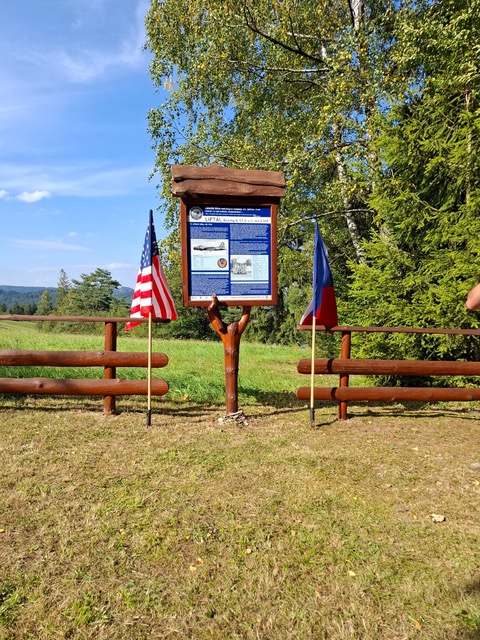
MarkerAn information board along a fence line.
The memorial remembers the crew of the B-17 (44-6369), Seaman's crew, of the 49th Bomber Squadron, 2nd Bomber Group, 15th Air Force that was shot down near here (about 1 kilometer further south, no maker is placed there). The entire crew survived and became POWs. The information board describes the B-17, the Crew and the mission on August 29, 1944.
On August 29, 2944, the 15th Air Force conducted "Mission 263", a raid on the Moravska Ostrava industrial complex (Current day city of Ostrava). Nine B-17Gs from 2nd Bomber Group were attacked by 89 German fighters and 20 minutes later eight of them were shot down and crashed in Slovakia (1), Czech Republic (7) and one crash landed in Hungary. 41 US airmen lost their lives, 28 of them were buried in a mass grave in Slavicin. Four fliers evaded capture and 55 airmen ended up in German POW camps. All the planes of the 20th Bomber Squadron, sister squadron of the 49th Squadron of the 2nd Bombardment Group, were shot down that day. Missing Air Crew Reports (MACR) 8084.
The crew of B-17 (44-6369), 49th Bomber Squadron, included (all were taken at POWs):
Several museums in the area also remember this battle. See sites: Sanov, Slavicin, and Bojkovice.
Search "Mission 263" for memorials and cenotaphs associated with this event on our website.
For more information, see the Air Battle over the White Carpathian website at: www.leteckabitvakarpaty.cz
Special thanks to Mission 263 - Aug 29, 1944 / Letecká bitva 29.8.1944 Facebook page & group for remembering this battle and for the several memorials that remember this mission.
Monument Text:
Letecká bitva nad Bílými Karpaty 29. SRPNA 1944
Umírali i za nai svobodu, nezapomínáme
Motto: Svet nebude znicen temi, co páchají zlo, ale temi, kterí se dívají, ani by proti tomu cokoliv udelali.
- Albert Einstein
LIPTÁL Boeing B-17 G s. n. 44-6369
On the left column:
II. svetová válka, rok 1944
V léte 1944 plynula válka v Evrope i Tichomorí do své záverecné fáze. Spojenci se vylodili v Normandii i na jihu Francie a postupovali Itálií na sever. Do její jiní cásti tak mohli Britové I Americané presunout své letecké základny ze severní Afriky. Dosah bombardovacích letounu 15. americké letecké armády se zvýil. Cíly náletu se staly, mimo jiné, oblasti ve Slezsku a v protektorátu Cechy a Morava.
Dne 27. srpna 1944 americký pruzkumný letoun nael na nádraí v Moravské Ostrave stovky vagónu s vojenským materiálem a velké mnoství cisteren na pohonné hmoty. Navíc byly poblí mení rafinerie na syntetický benzín v Prívoze a v Bohumíne. A k tomu rozsáhlá prumyslová oblast ve Vítkovicích. Velmi rychle byl pripraven plán letecké operace a 29. srpna 1944 za ranního rozbresku vyslala 15. americká letecká armáda z italských letit smerem na Ostravsko I k náletum na cíle v severní Itálii a Mad'arsku 599 bombardéru s doprovodem 250 stíhacek.
Boeing B-17G
Strategický celokovový bombardér pohánený ctyrmi hvezdicovými devítiválci
Wright Cyclone R-1820-97 s turbokompresory GE B-22.
|
posádka |
10 muu |
|
rozpetí |
31,62 m |
|
délka |
22,65 m |
|
max. hmotnost |
32 000 kg |
|
max. výkon 1 motoru |
1200 k |
|
max. rychlost |
480 km/h |
|
cestovní rychlost |
250 km/h |
|
dustup |
10 800 m |
|
béný dolet |
3000 km |
|
kulometna výzbroj |
13 × 12,7 mm |
|
max. náklad pum |
7800 kg |
|
|
|
Bombardovací letoun B-17G, sériové císlo: 44-6369
(Jednotka: 5. krídlo, 2. bombardovací skupina, 49. perut)
LETECKÝ SOUBOJ
Bombardér c. 44-6369 ze stavu 49. perute 2. bombardovací skupiny se v prubehu letu propadl ze své formace a k celu 20. perute, kde ho zastihl opakovaný útok nemeckých stíhacek po kterém dopadl na katastr obce Liptál v místech zvaných Vartovna (presneji receno vybuchl ji ve vzduchu a jeho trosky byly rozesety v prostoru cca 1 km²).
První útok vyradil motor c. 3 a pravá polovina krídla, pokozená mezi obema motory, chytila mohutným plamenem iveným palivem ze zasaené nádre. Dalí strely z útoku, který vzápetí následoval, zasáhly trup s rozvody kyslíku a horní streleckou ve a zpusobily pokození ovládání odhozu bomb. Pilot podporucík Seaman, který stejne jako druhý pilot a pravdepodobne i ostatní mui musel pouít prenosnou láhev s kyslíkem, vydal pres intercom pokyn k okamitému oputení paluby. Navigátor podporucík Mickadeit, bombometcík serant Hausler a mechanik serant Nigborowicz, který se stihl premístit po nouzovém uvolnení bomb v pumovnici do prední sekce, vyskocili predním otvorem. A na zadního strelce seranta Marthyho L. Childresse, jen pouil zadní únikový otvor, ostatní letci opustili palubu pumovnicí. Letoun s ohnivou vleckou pokracoval nekolik okamiku v sestupném letu a krátce nato se zrítil.
K tomu, abych si navlékl protiflakovou vestu, ji nedolo, napsal ve svých vzpomínkách první pilot Duan B. Seaman. Tim Reidy, ná spodní strelec hlásil, e zpozoroval ná stíhací doprovod. Záhy nato se vak rozpoutalo hotové peklo. Ve nekolika okamicich jsme meli díru v krídle mezi motory c. 1 a c. 2. Plameny dlouhé a 15 stop lehaly z horících be nádrí. Zasaenému motoru c. 3, z neho prýtil olej a stékal po krídle, upadla vrtule. Intercomem jsem opakovane vem narídil vyskocit.
On the right column:
Na rozdíl od ostatních se osud k osádce letounu podporucíka Seamana zachoval milosrdne; vech deset letcu dopadlo na zem a vichni upadli dríve ci pozdeji do rukou Nemcu. Dockali se konce války v zajetí. Podle nemeckých dokumentu zadrela ozbrojená hlídka Seamana mezi 12.00 a 13.00 hod. poblí Liptálu. Sám letec o svém zadrení napsal: Padal jsem radeji volným pádem a proletel tremi vrstvami mraku, ne jsem zatáhl za nuru a otevrel padák, který se divoce kroutil, protoe postroj nebyl pripnutý k levé noze. Tesne pred dopadem jsem padák pomocí popruhu rídil tak, abych se vyhnul stromum. Po velmi tvrdém pristání a po ukrytí padáku jsem si vimnul, e po peine nade mnou krácí dvouclenná ozbrojená hlídka. Nevím proc, snad z oku po predchozích událostech jsem si myslel, e by hlídka mohla být ve spojení s podzemním hnutím. Kdy se za chvíli vracela, zavolal jsem na ni a rekl jí, kdo jsem. Prátelsky jsme se pozdravili a ti dva me vzali do nejbliího stavení, kde jsem se setkal pribline s tuctem civilistu. Krátce nato si pro me priel nemecký voják s ceským policistou a strcil me do místního vezení.
Pribline ve stejnou dobu se podarilo zadret mezi Liptálem a Vsetínem radioperatora Devlina, strelce Childresse a Reidyho. Druhý pilot Pastorino upadl do zajetí okolo 14.00 hod. a bombometcík Hausler pak kolem 18.00 hodiny.
Zadrení sedmého letce jedenadvacetiletého navigátora podporucíka Mickadeita je zachyceno v kronice obce Liptál takto:
Jeden z letcu priel vecer do Liptálu do hostince ke Kleskum. Místní hosté se k nemu shlukli, porucili mu pivo a objednali veceri. Spolumajitelka hostince la pro starostu, který mel letce predat cetnictvu. Dríve ne se tak stalo, priel do hostince cetnický strámistr Nedvedík. Pilot, jakmile jej spatril, vstal od stolu a vzedl ruce. Strámistr Nedvidek jej prohledal a odvedl na cetnickou stanici. Obcané pozdeji cetníkum vytýkali, e ho nenechali ani snist veceri a e si pocinali prili komisné, ale na druhe strane je pravda, e strámistr Nedvedík nemohl vedet, kdo vechno jeho pocinani sleduje. Predtim, nez byl americký letec (Mickadeit) predán vsetinskemu gestapu, zasobili jej príslunici cetnické stanice jidlém a cigaretami.
Zbývajícím letcum se podárilo nekolik následujících dnu unikat, dva dny a dve noci je suovalo detivé pocasí, pred kterym se chránili pod vetvemi stromu prikryti nepotrebnými pogumovanými leteckými mapami. Hladoví, provlhlí a nachlazení byli po nekolika dnech zadreni.
POSÁDKA:
První pilot:
F/O. Duane B. Seaman zajat
Druhý pilot:
F/O. Ben J. Pastorino zajat
Navigátor:
1/Lt. Robert E. Mickadeit zajat
Bombometcík:
S/Sgt. Donald B. Hausler zajat
Palubní mechanik:
T/Sgt. John A. Nigborowicz zajat
Spodní strelec:
S/Sgt. Timothy J. Reidy zajat
Pravý bocní strelec:
S/Sgt. Robert C. Pittard zajat
Levý bocní strelec:
S/Sgt. Howard T. Ware zajat
Zadní strelec:
S/Sgt. Marty L. Childress zajat
Radiooperátor:
T/Sgt. William J. Devlin zajat
PO BITVE
Ze sta clenu posádek jich ctyricet jedna zahynulo, padesát pet upadlo do nemeckého zajetí, tri se dostali na Slovensko a odtud pozdeji behem tajné mise OSS (Office of Strategic Services), do Itálie. Jednoho letce ukrývala moravská rodina a do konce války. Dvacet osm letcu bylo pohrbeno v hromadném hrobe ve Slavicíne a zbylí na hrbitovech v obcích poblí míst dopadu jednotlivých letadel. Nemci prili o sedm letadel a dva jejich letci zahynuli. Pri bombardování Ostravy byly bohuel zasaeny i obytné oblasti a zahynulo pri tom 540 civilních osob.
Letecká bitva nad Bílými Karpaty byla dlouhé roky komunistickým reimem zámerne opomíjena a úcastníci se vzpomínkových akcí ci ti, kterí staveli pomnícky padlým letcum, byli pod bedlivým dohledem StB. Renesance prila a po roce 1989, kdy byla usporádána výstava k této události. Vzbudila nebyvalý ohlas a nadení, a to i v zahranicí, odkud zacali do Slavicína ke dni výrocí jezdit potomci obetí této letecké bitvy.
English translation:
Air Battle over the White Carpathians 29 AUGUST 1944
They also died for our freedom, we do not forget
Motto: The world will not be destroyed by those who do evil, but by those who look on without doing anything about it.
- Albert Einstein
LIPTÁL Boeing B-17G, serial no. 44-6369
On the left column:
World War II, year 1944
In the summer of 1944, the war in Europe and the Pacific was entering its final phase. The Allies landed in Normandy and in southern France, and advanced northward through Italy. Into its southern region, both the British and Americans were able to move their air bases from North Africa. The range of the bombers of the 15th U.S. Air Force increased. Targets of the raids became, among other areas, regions in Silesia and in the Protectorate of Bohemia and Moravia.
On 27 August 1944, an American reconnaissance aircraft located hundreds of railcars with military supplies and a large number of fuel tank wagons at the rail station in Moravská Ostrava. In addition, there were smaller refineries for synthetic gasoline nearby in Pívoz and Bohumín, as well as an extensive industrial area in Vítkovice. A plan for an air operation was prepared very quickly, and at dawn on 29 August 1944, the 15th U.S. Air Force launched from Italian airfields toward the Ostrava region and, for raids on targets in northern Italy and Hungary, 599 bombers accompanied by 250 fighters.
Boeing B-17G
A strategic all-metal bomber powered by four Wright Cyclone R-1820-97 nine-cylinder radial engines with GE B-22 turbochargers.
|
Crew |
10 men |
|
Wingspan |
31.62 m |
|
Length |
22.65 m |
|
Maximum weight |
32,000 kg |
|
Maximum power per engine |
1,200 hp |
|
Maximum speed |
480 km/h |
|
Cruising speed |
250 km/h |
|
Ceiling |
10,800 m |
|
Range |
3,000 km |
|
Machine-gun armament |
13 × 12.7 mm |
|
Maximum bomb load |
7,800 kg |
Bomber aircraft B-17G, serial number: 44-6369
(Unit: 5th Wing, 2nd Bombardment Group, 49th Squadron)
AIR COMBAT
Bomber no. 44-6369 of the 49th Squadron, 2nd Bombardment Group, during the course of the flight fell out of its formation down toward the tail of the 20th Squadron, where it was struck by repeated attacks from German fighters. After these attacks, it crashed on the cadastral territory of the village of Liptál in an area called Vartovna (more precisely, it exploded already in the air and its wreckage was scattered over an area of roughly 1 km²).
The first attack disabled engine no. 3, and the right half of the wing, damaged between both engines, caught a massive flame fed by fuel from the punctured tank. Further rounds from the following attack struck the fuselage with its oxygen lines and the upper gun turret, causing damage to the bomb-release controls. Pilot 2nd Lt. Seaman, wholike the co-pilot and probably the other crewmenhad to use a portable oxygen bottle, issued an order over the intercom for the immediate abandonment of the aircraft. Navigator 2nd Lt. Mickadeit, bombardier Sergeant Hausler, and mechanic Sergeant Nigborowicz, who managed to move from the bomb bay into the forward section after the emergency release of the bombs, jumped out through the forward hatch. Except for tail gunner Sergeant Marthy L. Childress, who used the rear escape hatch, the other airmen exited through the bomb bay. The aircraft, trailing fire, continued for several moments in a descending flight and shortly thereafter crashed.
I didnt even get the chance to put on my flak vest, wrote first pilot Duan B. Seaman in his memoirs. Tim Reidy, our ball gunner, reported sighting our fighter escort. Shortly afterward, all hell broke loose. Within seconds we had a hole in the wing between engines no. 1 and no. 2. Flames up to fifteen feet long were shooting from the burning fuel tanks. From engine no. 3, oil was spurting and running down the wing, and the propeller had fallen off. Over the intercom, I repeatedly ordered everyone to jump.
On the right column:
Unlike others, fate was merciful to the crew of 2nd Lt. Seamans aircraft; all ten airmen landed on the ground and all sooner or later fell into German hands. They lived to see the end of the war in captivity. According to German documents, an armed patrol captured Seaman between 12:00 and 13:00 near Liptál. The airman wrote of his capture: I preferred to fall in a free fall and pass through three layers of clouds before I pulled the ripcord and opened the parachute, which twisted wildly because the harness was not fastened to my left leg. Just before impact I steered the parachute with the straps so I would avoid trees. After a very hard landing and hiding the parachute, I noticed a two-man armed patrol walking along the path above me. I dont know whyperhaps from shock after the previous eventsI thought the patrol might be connected with the resistance movement. When they returned a moment later, I called to them and told them who I was. We greeted each other in a friendly manner and the two men took me to the nearest house, where I met roughly a dozen civilians. Shortly afterward a German soldier with a Czech policeman arrived and put me into the local jail.
At about the same time, radioman Devlin, gunner Childress, and Reidy were captured between Liptál and Vsetín. The co-pilot Pastorino was captured around 14:00, and bombardier Hausler around 18:00.
The capture of the seventh airman, the 21-year-old navigator 2nd Lt. Mickadeit, is described in the chronicle of the village of Liptál as follows:
One of the airmen came in the evening to the inn at the Klesk family. Local guests gathered around him, ordered him beer and dinner. The co-owner of the inn went for the mayor, who was supposed to hand the airman over to the gendarmerie. Before this happened, gendarme sergeant Nedvdík arrived at the inn. When the pilot saw him, he rose from the table and raised his hands. Sergeant Nedvdík searched him and led him to the gendarmerie station. Later, citizens criticized the gendarmes, saying they didnt even let him eat his dinner and behaved too harshly. On the other hand, its true that Sergeant Nedvdík couldnt know who was watching his actions. Before the American airman (Mickadeit) was handed over to the Vsetín Gestapo, the gendarmes at the station supplied him with food and cigarettes.
The remaining airmen managed to evade capture for several more days; for two days and two nights they were tormented by rainy weather, which they sheltered from under tree branches, covered with discarded rubberized aviation maps. Hungry, soaked, and chilled, they were arrested after several days.
CREW:
First Pilot:
F/O Duane B. Seaman captured
Second Pilot:
F/O Ben J. Pastorino captured
Navigator:
1/Lt Robert E. Mickadeit captured
Bombardier:
S/Sgt Donald B. Hausler captured
Flight Engineer/Top Turret Gunner:
T/Sgt John A. Nigborowicz captured
Ball Turret Gunner:
S/Sgt Timothy J. Reidy captured
Right Waist Gunner:
S/Sgt Robert C. Pittard captured
Left Waist Gunner:
S/Sgt Howard T. Ware captured
Tail Gunner:
S/Sgt Marty L. Childress captured
Radio Operator:
T/Sgt William J. Devlin captured
AFTER THE BATTLE
Out of one hundred crew members, forty-one were killed, fifty-five fell into German captivity, and three managed to reach Slovakia and later, during a secret OSS (Office of Strategic Services) mission, were transported to Italy. One airman was hidden by a Moravian family until the end of the war. Twenty-eight airmen were buried in a mass grave in Slaviín, and the others in cemeteries in villages near the crash sites of the individual aircraft. The Germans lost seven aircraft, and two of their airmen were killed. During the bombing of Ostrava, residential areas were unfortunately hit as well, and 540 civilians were killed.
For many years, the Air Battle over the White Carpathians was deliberately ignored by the communist regime, and participants in commemorative events, as well as those who built memorials to the fallen airmen, were closely monitored by the State Security (StB). A renewal of interest came only after 1989, when an exhibition devoted to this event was organized. It received an unprecedented response and enthusiasm, including from abroad, where descendants of the victims began traveling to Slaviín on the anniversary of this air battle.
Commemorates:
People:
Robert Cnristopher, Sr. Pittard
Units:
15th Air Force
2nd Bomber Group
49th Bomber Squadron, 2nd Bomber Group
Wars:
WWII
Other images :


